We research products independently. When you buy through links on this page, we may earn a commission from Amazon at no extra cost to you. As an Amazon Associate we earn from qualifying purchases. Read our affiliate disclosure.
A good lathe tool sharpening jig does one job: it puts the same bevel on the same tool every time. That consistency is what makes turning feel easier. When your bowl gouge has the same angle on Saturday as it did on Tuesday, you stop relearning the tool and start turning.
What matters most is the whole system, not one gadget. You need a grinder that runs slowly enough to stay in control, wheels that suit your steel, and a jig that fits the grinder and covers the tools you own. Below are seven picks, from jig bases to complete wet and belt sharpeners, with the specs each maker publishes. For the technique itself, see how to sharpen lathe tools.
Our top picks at a glance


Quick picks
- Best Overall Jig: Oneway Wolverine Grinding Jig. Best for the standard V-arm and platform system most turners learn on.
- Best Fingernail Gouge Jig: Oneway Vari-Grind 2. Best for repeatable fingernail and swept-back bowl gouge grinds.
- Best Value Jig System: RIKON 82-1005 Pro Sharpening System. Best for a Wolverine-style base, arm and platform for 6- or 8-inch grinders.
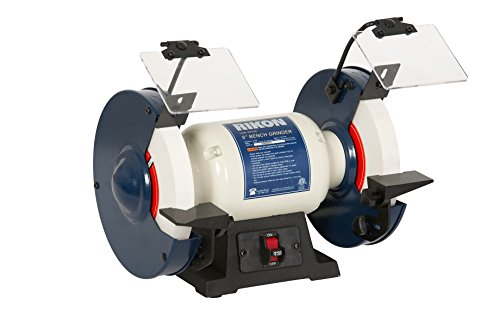
- Best Slow-Speed Grinder: RIKON 80-805. Best for a 1,750 RPM grinder with 60 and 120 grit wheels and a five-year warranty.
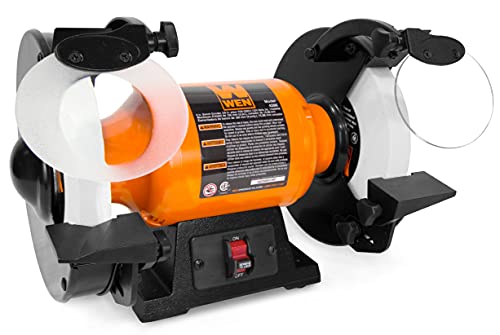
- Best Budget Grinder: WEN BG4286. Best for a low-cost 1,750 RPM grinder to build a jig system on.
- Best Water-Cooled System: Tormek T-8 Magnum Kit. Best for slow, cool, very controlled sharpening of every tool in the shop.
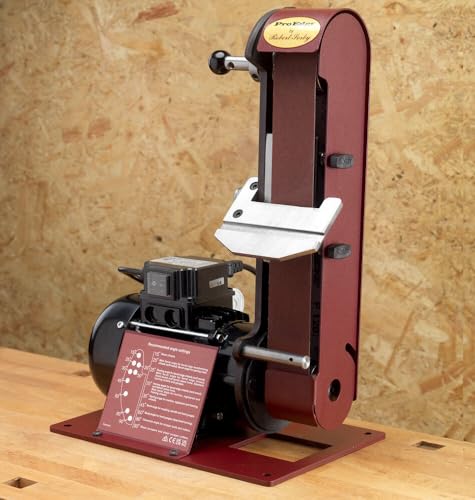
- Best Belt Sharpener: Robert Sorby ProEdge. Best for fast, flat bevels with preset angles and many belt grits.
Comparison table
| Product | Best for | Type | Key spec | Speed | Amazon |
|---|---|---|---|---|---|
| Oneway Wolverine Grinding Jig | Overall jig | Jig base, V-arm, platform | Two bases, 27-1/2 in. V-arm, platform | Use on a slow-speed grinder | Check price |
| Oneway Vari-Grind 2 | Fingernail grinds | Gouge jig attachment | Tools up to 3/4 in. diameter | n/a | Check price |
| RIKON 82-1005 | Value jig system | Jig bases, V-arm, platform | Fits 6- or 8-inch grinders | Use on a slow-speed grinder | Check price |
| RIKON 80-805 | Grinder | 8 in. dry grinder | 1/2 HP, 8 x 1 in. 60/120 grit wheels | 1,750 RPM | Check price |
| WEN BG4286 | Budget grinder | 8 in. dry grinder | 3 A, 8 x 1 in. 60/120 grit wheels | Up to 1,750 RPM | Check price |
| Tormek T-8 Magnum Kit | Water-cooled | Wet stone sharpener | 250 x 50 mm stone, 200 W motor | About 90–100 RPM | See options |
| Robert Sorby ProEdge | Belt system | Belt sharpener | 2 in. belt, 1/2 HP | About 1,400 ft/min belt speed | Check price |




The best sharpening jigs and grinders, reviewed
1. Oneway Wolverine Grinding Jig: Best Overall Jig
Who it's for: anyone with an 8-inch grinder who wants the system most woodturning classes and books are built around.
The Wolverine is the reference point for turning-tool jigs. Oneway's complete jig (part 2291) includes two bases, a V-arm and a platform. The bases mount under each wheel, the 27-1/2-inch V-arm slides in and out of one base to set the bevel angle for gouges, and the flat platform (3 x 5 inches) handles scrapers and parting tools. Oneway lists the V-arm for gouges, chisels up to 1-1/4 inches, skews and carving tools.
Oneway designed the system for 8-inch aluminum oxide wheels on a 1/2 to 1 HP bench or pedestal grinder. Its instructions say to mount the grinder and both bases on one board, center each base under its wheel with the front of the base flush with the front of the wheel, and add a spacer of about 1 inch under a 6-inch grinder. Oneway backs the jig for five years. Add-ons include the Vari-Grind 2 for fingernail grinds, a skew jig (2690) and a mini platform.
Pros
- The most widely taught jig system for turning tools
- V-arm and platform cover gouges, skews, scrapers and parting tools
- Five-year warranty
- Expandable with Oneway's gouge and skew attachments
Cons
- Needs careful mounting on a board under the grinder
- Fingernail grinds need the separate Vari-Grind
- Retail stock is sometimes backordered
2. Oneway Vari-Grind 2 Attachment: Best Fingernail Gouge Jig
Who it's for: bowl turners who want the same fingernail or swept-back grind every time.
The Vari-Grind 2 holds a gouge at a set angle while you swing and roll it, which is what produces a fingernail profile. Oneway rates it for tools up to 3/4 inch in diameter and lists fingernail, traditional bowl gouge and side (Irish) grinds. Oneway's 2010 instructions describe it as restraining the tool from moving side to side and at the pivot, and the AAW's sharpening-jig article names Oneway as one of the makers whose jigs eliminate accidental sideways movement.
It is sold without a base (3900) or with one (3920). Oneway does not publish leg-angle or protrusion settings, so you set it once to match a bevel you like and then repeat that setting with a stop block or gauge.
Pros
- Repeatable fingernail and Irish grinds
- Handles bowl and spindle gouges up to 3/4 in.
- Restrains side-to-side movement
- Works with the Wolverine bases and V-arm
Cons
- Requires a Wolverine-style system to use
- No published setting chart from Oneway
- Retailers describe the mounting differently, so check the instructions
3. RIKON 82-1005 Pro Sharpening System: Best Value Jig System
Who it's for: turners who want a Wolverine-style setup from a single brand, often alongside a RIKON grinder.
RIKON's Pro Sharpening System includes two locking bases, a long V-arm, a short 90-degree platform arm with a platform, and mounting hardware. RIKON says it suits 6- or 8-inch grinders. That covers the same core jobs as the Wolverine: gouges in the V-arm, scrapers and parting tools on the platform.
RIKON sells matching add-ons: a skew jig (82-1006), a fingernail jig (82-1007) and an angle gauge (82-1008). It is a sensible choice if you want one support line for grinder and jig.
Pros
- Two bases, V-arm and platform in one box
- Fits 6- or 8-inch grinders
- Matching skew, fingernail and angle-gauge add-ons
- Single-brand pairing with RIKON grinders
Cons
- Fingernail jig is a separate purchase
- Less community setup material than the Wolverine
- Specs beyond the parts list are not published on RIKON's page
4. RIKON 80-805 8 in. Low Speed Grinder: Best Slow-Speed Grinder
Who it's for: turners building their first proper sharpening station.
The 80-805 is the grinder we would put under a Wolverine or RIKON jig. It runs at 1,750 RPM, the speed the AAW recommends for turning tools, with a 1/2 HP, 3-amp, 120V motor. It ships with two 8 x 1-inch wheels (60 and 120 grit) on a 5/8-inch arbor, which is the size most aftermarket and CBN wheels use. A diamond-faced wheel dresser is included, and the left tool rest has a groove for drill bits. RIKON covers it for five years.
For heavier use, RIKON also lists the 80-820, a 1 HP, 1,750 RPM grinder with 1-1/2-inch-wide wheels, though it was out of stock on RIKON's site when we checked.
Pros
- 1,750 RPM, the AAW-recommended speed
- 60 and 120 grit wheels plus a diamond dresser
- Standard 5/8 in. arbor for CBN upgrades
- Five-year warranty
Cons
- 1-inch wheels are narrow for wide skews
- Stock rests are basic; most turners add a jig
- 1/2 HP slows under heavy reshaping
5. WEN BG4286 Slow Speed Bench Grinder: Best Budget Grinder
Who it's for: budget buyers who want the right speed for turning tools without paying for extras.
The BG4286 is WEN's current slow-speed model. WEN lists a 3-amp soft-start motor running up to 1,750 RPM, two 8 x 1-inch aluminum oxide wheels (60 and 120 grit) and a 5/8-inch arbor, so it accepts the same jigs and upgrade wheels as pricier grinders. The warranty is two years.
One caution: WEN also sells grinders that are not slow-speed. The older BG4282, for example, runs at 3,450 RPM. Check the RPM on any listing before you buy, and see our variable speed bench grinder guide for how low those dials really go.
Pros
- 1,750 RPM at a budget price
- 60 and 120 grit wheels included
- Standard 5/8 in. arbor
- Soft-start motor
Cons
- Two-year warranty
- No dresser mentioned in WEN's listing
- Similar-looking WEN models run at 3,450 RPM
6. Tormek T-8 Magnum Kit: Best Water-Cooled System
Who it's for: turners who also sharpen chisels, plane irons and knives, and anyone who wants zero risk of overheating an edge.
The Tormek is a different approach. Instead of a fast dry wheel, the T-8 Original turns a 250 x 50 mm (about 10 x 2 in.) SG-250 aluminum oxide stone through a water trough. Tormek's current page lists 100 RPM, while some older Tormek spec pages list 90 RPM; either way, it is far slower than any grinder. A 200 W continuous-duty motor drives it, and a leather honing wheel (LA-220) on the other side polishes the edge. Tormek's warranty is five years, extended to eight when you register within 90 days.
For turning tools you need Tormek's TNT-808 Woodturner's Kit. On Amazon the T-8 is sold in kits, and the Magnum Kit bundles the T-8 Original with both the TNT-808 and a hand tool jig kit for knives, scissors, axes and carving tools. The TNT-808 adds the SVD-186 R gouge jig, SVS-50 multi jig for skews and parting tools, SVD-110 tool rest for scrapers, TTS-100 turning tool setter and a profiled honing wheel. The TTS-100 chart gives settings for common grinds, for example a 45° standard bowl gouge and a 55° grind for deep bowls.
Pros
- Water cooling cannot overheat an edge
- Leather honing wheel gives a polished edge
- Woodturner's kit and hand tool kit included
- Up to eight-year warranty with registration
Cons
- Slow for reshaping a new grind
- Premium price tier
- Less convenient for quick touch-ups mid-bowl

Tormek T-8 Magnum Kit (T-8 Original + Hand Tool Kit + TNT-808 Woodturner's Kit)
by Tormek
Currently unavailable on Amazon
7. Robert Sorby ProEdge Sharpening System: Best Belt Sharpener
Who it's for: turners who want fast, flat bevels and easy grit changes, especially on skews and parting tools.
The ProEdge uses a 2-inch-wide abrasive belt instead of a wheel. The US version runs on 110V with a 1/2 HP motor; Sorby's product page lists a belt speed of 1,440 ft/min and its manual about 1,400 ft/min. It comes with one 120-grit aluminum oxide belt, and Sorby sells aluminum oxide, zirconium, ceramic, Trizact and diamond belts. A belt does not go out of round and never needs dressing.
The angle setter has presets from 15 to 90 degrees. Sorby's guide plate lists 15° for skews, 20° for parting tools, 45° for roughing, spindle and bowl gouges, 60° for deep bowl gouges and 80° for scrapers. For gouges, Sorby sells a woodturning kit with a fingernail profile jig and a skew jig.
Pros
- Belts never need dressing and stay flat
- Quick grit changes, from coarse to very fine
- Preset angle stops make setup fast
- Wide 2-inch belt suits skews
Cons
- Premium price tier
- Gouge jigs are a separate kit
- Belts are an ongoing cost
Buying guide: choosing a lathe tool sharpening jig
Start with grinder speed
The AAW's Safety Guidebook for Woodturners says about 1,750 RPM is the best single speed for sharpening turning tools, and that the common 3,600 RPM grinder is much too fast. If you use a variable-speed grinder, the AAW says to start it at its lowest speed. Buy the grinder first and the jig second, because the jig must match the grinder's wheel size and height.
Match the jig to the grinder
Oneway's Wolverine is designed for 8-inch wheels on 1/2 to 1 HP grinders, with a spacer under 6-inch grinders. RIKON's 82-1005 lists 6- and 8-inch grinders. Grinders with heavy cast-iron guards or rests may need modification, per Oneway. Mount the grinder and jig bases on one board so the alignment never shifts.
Dry wheel, wet stone or belt
- Dry grinder plus jig: fastest for reshaping and quick touch-ups. The most common setup among turners.
- Water-cooled stone (Tormek): slow, cool and precise. Best if you also sharpen flat tools and knives. See our Tormek vs bench grinder comparison.
- Belt (ProEdge): fast, flat and no dressing. Grit changes take seconds.
Aluminum oxide vs CBN wheels
Aluminum oxide wheels are affordable and come with most grinders, but they wear out of round and need regular dressing. The AAW's sharpening introduction notes that friable aluminum oxide wheels must be used with guards in place. CBN wheels hold their size and balance and do not need dressing. Most 8-inch grinders, including the RIKON 80-805 and WEN BG4286, use a 5/8-inch arbor, which is the common CBN wheel bore. If you upgrade, buy a wheel made for slow-speed grinders.
Mount it properly
Bolt the grinder and jig bases to one board or stand so nothing shifts between sessions, and give the station its own dust collection. The AAW's dust article recommends a shop vacuum of at least 70 cfm on the grinder, kept separate from your wood dust system because grinding throws sparks. Good light at the wheel helps too. For other shop upgrades around the lathe, see our wood lathe accessories guide.
What each attachment does
| Tool | Attachment | Amazon |
|---|---|---|
| Bowl and spindle gouges, fingernail grind | Gouge jig (Vari-Grind 2, RIKON 82-1007, Tormek SVD-186 R) | See options |
| Spindle roughing gouge | V-arm alone | See options |
| Skew chisel | Skew jig or platform | See options |
| Parting tool | Platform | See options |
| Scrapers | Platform at a steep angle | See options |
Safety features that matter
The AAW's article on sharpening jigs says most jig accidents come from tools sliding off the wheel, arms slipping, or the tool tip sitting near the wheel's equator. Look for jigs that lock firmly and restrain side-to-side movement, hold the jig from the top, and favor more acute bevels that keep the tip higher on the wheel. Wear a face shield or safety glasses at the grinder, and a dust mask when dressing wheels.
Price tiers
- Budget: a slow-speed grinder like the WEN BG4286 plus a jig base system.
- Mid-range: RIKON 80-805 with a Wolverine or RIKON jig and a fingernail attachment.
- Premium: Tormek T-8 with the woodturner's kit, Sorby ProEdge, or a grinder fitted with CBN wheels.
Pair your sharpening system with good steel; see our best wood lathe tools and best lathe chisels. Carbide insert tools are the exception: see our carbide lathe tools guide.
How we chose
We did not test these products ourselves. We compared manufacturer specifications, manuals and setup instructions from Oneway, RIKON, WEN, Tormek and Robert Sorby, checked them against major retailer listings, and weighed them against the AAW's guidance on grinder speed and jig safety. We left out grinders whose listed speed is above 1,750 RPM, and where makers' own pages disagreed (such as Tormek's speed and the ProEdge belt speed), we say so.
FAQ
What is the best sharpening jig for lathe tools?
For most turners, the Oneway Wolverine Grinding Jig on an 8-inch slow-speed grinder, with a Vari-Grind 2 added for fingernail gouges. It repeats the same bevel every time and covers gouges, skews, parting tools and scrapers.
Do I need a slow-speed grinder for woodturning tools?
It is strongly recommended. The AAW's Safety Guidebook for Woodturners says about 1,750 RPM is the best single speed for sharpening turning tools and calls the common 3,600 RPM grinder much too fast for efficient sharpening.
Will a Wolverine jig fit my grinder?
Oneway designed it for 8-inch wheels on a 1/2 to 1 HP bench or pedestal grinder. Its instructions say 6-inch grinders may need a spacer about 1 inch thick under the grinder, and heavy grinders with cast-iron rests or guards may need modification.
Is a Tormek better than a grinder for lathe tools?
It is different. A Tormek runs a large wet stone at about 90 to 100 RPM, so it cannot overheat the tool and removes steel slowly. A dry grinder with a jig is faster for reshaping and touch-ups between cuts. Choose the grinder if speed matters most and the Tormek if control and edge polish matter most.
What grit wheel is best for sharpening lathe tools?
Oneway suggests 80 and 120 grit for finishing gouges and small tools, with 54 or 80 grit for roughing large tools. The AAW's sharpening introduction suggests a coarse 80 to 180 grit wheel paired with a fine 350 to 600 grit wheel if you use CBN.
Verdict
The best lathe tool sharpening setup for most turners is a RIKON 80-805 slow-speed grinder with the Oneway Wolverine Grinding Jig and a Vari-Grind 2. On a tight budget, put a RIKON 82-1005 jig system on a WEN BG4286. If you want slow, cool, polished edges for every tool in the shop, the Tormek T-8 with the woodturner's kit is the premium answer, and the Sorby ProEdge is the fastest way to flat, repeatable bevels.
Related: see our best 8-inch bench grinders guide.