We research products independently. When you buy through links on this page, we may earn a commission from Amazon at no extra cost to you. As an Amazon Associate we earn from qualifying purchases. Read our affiliate disclosure.
The short answer: buy JET if you want a capable, well-supported lathe for the least money, and buy Powermatic if you want the heaviest, slowest-starting, most feature-rich machine you can fit in your shop. In the Powermatic vs JET lathe decision you are not choosing between rival companies. Both brands belong to JPW Industries, both use MT2 tapers, and both carry a five-year warranty. Powermatic is the premium line; JET covers more of the hobby and midi market.
The real choice is model against model. On a bench, that means the JET JWL-1221VS against the Powermatic PM2014B. On the floor, it means the JET JWL-1640EVS against the Powermatic 3520C. Below we compare them on the specs each brand publishes, then tell you who should buy which.
Our top picks at a glance
Side-by-side: the four models that matter
| JET JWL-1221VS | Powermatic PM2014B | JET JWL-1640EVS | Powermatic 3520C | |
|---|---|---|---|---|
| Class | Benchtop midi | Benchtop | Floor | Floor |
| Swing over bed | 12-1/2 in. | 14-1/4 in. | 16-1/2 in. | 20 in. |
| Between centers | 20-1/2 in. | 19-1/4 in. | 40 in. | 36 in. (35 in. in some listings) |
| Motor | 1 HP, 115V | 1 HP, 120V input | 1-1/2 HP, 115V input | 2 HP, 220V 1Ph |
| Speed range | 60–3,600 RPM (3 ranges) | 15–3,600 RPM (3 ranges) | 40–3,200 RPM (2 ranges) | 15–3,200 RPM (2 ranges) |
| Spindle thread | 1 in. x 8 TPI | 8 TPI (diameter not stated) | 1-1/4 in. x 8 TPI | 1-1/4 in. x 8 TPI |
| Indexing | See manual | 24 positions | See manual | 48 positions |
| Weight | 121 lb | 172 lb | 377 lb | 726 lb net |
| Warranty | 5 years | 5 years | 5 years | 5 years |
| Amazon | Check price | Check price | Check price | Check price |


Specs come from JET's and Powermatic's product pages and literature, checked against retailer listings. Where a maker does not publish a figure, we say so.
The differences, one by one
1. Low-end speed
This is where Powermatic pulls ahead. The PM2014B and 3520C start at 15 RPM. The JET JWL-1221VS starts at 60 RPM and the JWL-1640EVS at 40 RPM.
Does that matter? For spindles and pens, no. For bowls, a low start is a real safety and comfort feature: the AAW advises starting any unbalanced blank at the lathe's lowest speed and increasing only while the work runs smoothly. Sixty RPM is already slow enough for most bowl blanks a 12-inch lathe can swing. Fifteen RPM matters most on big, out-of-round blanks, which is exactly what the 3520C is built for. Our wood lathe speed chart explains how to set speed on any lathe.
2. Capacity
On the bench, the PM2014B swings 14-1/4 inches against the JET's 12-1/2, which is about 1-3/4 inches more bowl diameter. The JET has slightly more distance between centers (20-1/2 against 19-1/4 inches) and JET sells a bed extension for it.
On the floor, the 3520C's 20-inch swing is the reason people buy it. The JWL-1640EVS swings 16-1/2 inches but offers a longer 40-inch bed, which favors spindle turners: table legs, bedposts and long balusters.
3. Mass and vibration
Weight is the quiet spec that separates premium lathes. The PM2014B weighs 172 lb against the JWL-1221VS's 121 lb. The 3520C, at 726 lb net, weighs nearly twice as much as the JWL-1640EVS at 377 lb. More cast iron absorbs vibration from unbalanced work, and that shows up as cleaner cuts and less lathe walk. A JET can be made steadier with a good stand and sandbags on a shelf; see our wood lathe stand guide.
4. Motor and drive
Powermatic uses inverter-driven three-phase motors across its line; its site lists a digital readout and sliding headstock on its current lathes. The 3520C has a 2 HP motor on 220V, which means you need a 220V circuit. JET's 1221VS runs on a 115V household outlet, and the JWL-1640EVS lists 115V input with 1-1/2 HP, so neither needs new wiring. That alone settles the question for many garage shops.
5. Headstock and features
The PM2014B has a sliding headstock, which lets you move the headstock toward the tailstock end and stand in a more comfortable position for bowl work. It also has 24 indexing positions. The 3520C pairs a sliding headstock with 48 indexing positions. The JWL-1221VS offers forward and reverse with a digital readout, which covers what most hobby turners use. Check each model's current manual for the full feature list before you buy, since minor features change between revisions.
6. Price tier
JET lathes sit in the mid-range tier. The JWL-1221VS is one of the most common upgrades from a budget mini, and the JWL-1640EVS is an affordable entry into floor lathes. Powermatic sits a tier higher in both classes. The 3520C is one of the most expensive lathes a home shop typically buys, and the PM2014B costs noticeably more than the JET midi. Check current prices, as they change often.
7. Warranty and support
Both brands carry five-year warranties and share JPW's US service network, so parts and support are similar. JET calls its program Red Assurance. Buy from an authorized seller to keep the warranty intact. Both brands also hold their resale value well; used examples are covered in our used wood lathe buying guide.
Benchtop: JET JWL-1221VS vs Powermatic PM2014B
Choose the JET JWL-1221VS if you turn pens, spindles, boxes and bowls up to about 10 inches, want the most capability for the money, and like forward/reverse for sanding.
Choose the Powermatic PM2014B if you want more swing on a bench, a 15 RPM start for out-of-round blanks, a sliding headstock and the extra mass of a 172 lb machine.
JET JWL-1221VS
The 1221VS is the midi lathe many turners keep for years. It has a 1 HP, 115V motor, electronic variable speed from 60 to 3,600 RPM in three belt ranges, forward and reverse, and a digital readout. Capacity is 12-1/2 inches of swing and 20-1/2 inches between centers, with a 1 in. x 8 TPI spindle and MT2 tapers, so almost every mini and midi accessory fits. More detail is in our JET wood lathe review.

JET JWL-1221VS 12 in. x 21 in. Variable Speed Wood Lathe
by JET
Powermatic PM2014B
The PM2014B brings Powermatic's design to a bench. It swings 14-1/4 inches with 19-1/4 inches between centers, runs a 1 HP motor from 120V input, and spans 15 to 3,600 RPM in three ranges. It has a sliding headstock, 24 indexing positions and weighs 172 lb. Powermatic's page lists the spindle as 8 TPI without the diameter, so confirm the thread before buying a chuck insert. Our Powermatic wood lathe review covers the whole lineup.

Powermatic PM2014B 14 in. x 20 in. Variable Speed Woodworking Benchtop Lathe
by Powermatic
Floor lathes: JET JWL-1640EVS vs Powermatic 3520C
Choose the JET JWL-1640EVS if you want a full-size lathe on a 115V circuit, turn long spindles as well as bowls, and want to stay in the mid-range tier.
Choose the Powermatic 3520C if you turn large bowls and hollow forms, have or can add a 220V circuit, and want a lathe you will never outgrow.
JET JWL-1640EVS
The 1640EVS swings 16-1/2 inches over the bed with 40 inches between centers. Its 1-1/2 HP motor runs from 115V input with two speed ranges covering 40 to 3,200 RPM. The spindle is 1-1/4 in. x 8 TPI, the full-size standard, and the lathe weighs 377 lb. It is a natural step up from a midi for turners who want more bed length.
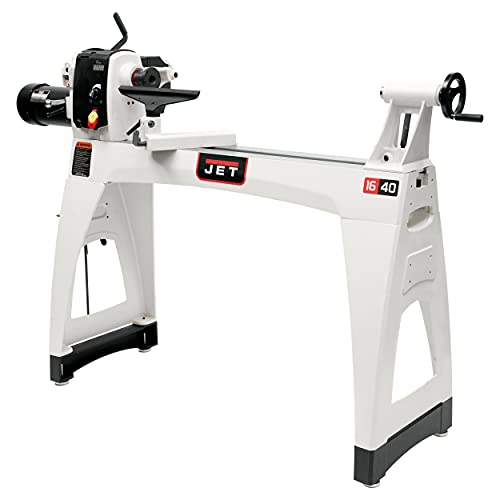
JET JWL-1640EVS 16 in. x 40 in. Electronic Variable Speed Wood Lathe
by JET
Powermatic 3520C
The 3520C is the reference 20-inch lathe in many American shops. It swings 20 inches with about 36 inches between centers (some listings say 35), has a 2 HP, 220V single-phase motor driving two speed ranges from 15 to 1,200 and 40 to 3,200 RPM, 48 indexing positions and a 1-1/4 in. x 8 TPI spindle. At 726 lb net it is the heaviest lathe here by far.

Powermatic 3520C 20 in. x 35 in. Woodworking Lathe, 2 HP, 1Ph 220V
by Powermatic
Accessory compatibility
Both brands use MT2 tapers in the headstock and tailstock, so drive centers, live centers, drill chucks and pen mandrels move between them. Spindle threads differ by size class: 1 in. x 8 TPI on the JWL-1221VS, 1-1/4 in. x 8 TPI on the JWL-1640EVS and Powermatic's floor lathes. If you plan to upgrade from a JET midi to a Powermatic floor lathe later, buy a chuck with an insert system so only the insert needs replacing. Our lathe spindle thread size chart lists the threads of common lathes.
What about Grizzly?
Many buyers add Grizzly to the comparison. Grizzly mostly sells direct and competes on price and feature lists. We do not cover its lathes model by model here, so compare current Grizzly specs against the table above on the same points: low-end speed, swing, weight, motor voltage, spindle thread and warranty.
Common mistakes
- Buying the brand instead of the model. A JET floor lathe and a Powermatic benchtop serve very different turners.
- Forgetting the outlet. The 3520C needs 220V. Check your panel before you order.
- Ignoring the thread. A 1 in. x 8 TPI chuck will not fit a 1-1/4 in. x 8 TPI spindle without an adapter or insert.
- Skipping the stand. Benchtop lathes need a rigid, heavy base. A wobbly bench wastes a good lathe.
- Paying for swing you will not use. If you turn pens and small bowls, a 20-inch lathe is an expensive way to take up floor space; see our benchtop vs floor lathe comparison.
How we compared
We did not test these lathes ourselves. We compared the specifications JET and Powermatic publish on their product pages and in their literature with major retailer listings, and weighed them against the AAW's guidance on lathe speed and lathe buying. We matched models by class, benchtop against benchtop and floor against floor, because that is how buyers actually choose. Where a maker leaves a figure out, such as the PM2014B's spindle diameter, we say so rather than fill the gap.
FAQ
Is Powermatic better than JET?
Powermatic is the premium line and its lathes are heavier, start slower and add features such as sliding headstocks and inverter drives. JET lathes cost less and cover more of the hobby market. Both belong to JPW Industries and both carry five-year warranties, so the better brand is the one whose model fits your work and budget.
Are JET and Powermatic made by the same company?
Yes. Both brands belong to JPW Industries. Powermatic is positioned as the premium brand, and JET covers more of the hobby and midi market.
Should I buy the Powermatic PM2014B or the JET JWL-1221VS?
Buy the JET JWL-1221VS if you want a proven 12-inch midi with a 60 RPM start, reverse and a digital readout for less money. Buy the Powermatic PM2014B if you want more swing (14-1/4 inches), a 15 RPM start, a sliding headstock and 172 lb of mass on a bench.
What about Powermatic vs JET vs Grizzly?
Grizzly sells mostly direct and competes on price with long feature lists. JET and Powermatic are sold through dealers and large retailers with US service networks and five-year warranties. If budget is the main constraint, compare Grizzly's current specs model by model; if support and resale value matter more, JET and Powermatic hold up well.
Do JET and Powermatic lathes use the same accessories?
Mostly. Both brands use MT2 tapers in the headstock and tailstock. Spindle threads vary by model: the JWL-1221VS uses 1 in. x 8 TPI, while the JWL-1640EVS and Powermatic's floor lathes use 1-1/4 in. x 8 TPI. Powermatic's PM2014B page lists 8 TPI without the diameter, so confirm before buying a chuck insert.
Verdict
For most home turners, JET is the better value: the JWL-1221VS on a bench or the JWL-1640EVS on the floor gives you standard accessories, household power and a five-year warranty. Choose Powermatic when you want a 15 RPM start, more mass and a sliding headstock, and when the PM2014B or 3520C fits your budget and your shop. For more options across brands, see our best wood lathe guide.