We research products independently. When you buy through links on this page, we may earn a commission from Amazon at no extra cost to you. As an Amazon Associate we earn from qualifying purchases. Read our affiliate disclosure.
Bowl turning asks more of a lathe than spindle work. A bowl blank is wide, often heavy, sometimes wet and almost never perfectly balanced, so the lathe needs swing for the diameter, a low starting speed for safety and enough mass to stay put when the blank wobbles.
That is why the best lathe for bowl turning is rarely the cheapest benchtop model. Below are seven lathes from JET, Laguna, Powermatic and RIKON, from a 12-inch starter up to a sliding-bed giant, compared on the three specs that matter most for bowls.
Our top picks at a glance


Quick picks
- Best Overall for Bowls: JET JWL-1640EVS. Best for 16-inch swing, a 40 RPM start and floor-lathe mass on 115V.
- Best for Large Bowls: Laguna Revo 18|36. Best for 18-inch swing, a 50 RPM start and outboard turning.
- Best Premium: Powermatic 3520C. Best for a 20-inch, 726 lb lathe that starts at 15 RPM.
- Best Benchtop for Bowls: RIKON 70-1420VSR. Best for 14-inch swing and a full-size spindle on a bench.
- Best Starter Lathe for Bowls: JET JWL-1221VS. Best for learning bowls on a midi that starts at 60 RPM.
- Best Step-Up on 110V: Laguna Revo 15|24. Best for 15-1/2-inch swing on a household circuit.
- Best for Platters and Huge Bowls: RIKON 70-3040. Best for very large work on a motorized sliding bed.
Comparison table
| Lathe | Best for | Swing over bed | Lowest speed | Motor | Spindle thread | Weight | Amazon |
|---|---|---|---|---|---|---|---|
| JET JWL-1640EVS | Overall | 16-1/2 in. | 40 RPM | 1-1/2 HP, 115V input | 1-1/4 in. x 8 TPI | 377 lb | Check price |
| Laguna Revo 18|36 | Large bowls | 18 in. | 50 RPM | 1.5 HP 110V or 2 HP 220V, VFD | 1-1/4 in. x 8 TPI | 427 lb net | Check price |
| Powermatic 3520C | Premium | 20 in. | 15 RPM | 2 HP, 220V | 1-1/4 in. x 8 TPI | 726 lb net | Check price |
| RIKON 70-1420VSR | Benchtop | 14 in. | 150 RPM | 1-1/2 HP, 115V | 1-1/4 in. x 8 TPI | 137 lb | See options |
| JET JWL-1221VS | Starter | 12-1/2 in. | 60 RPM | 1 HP, 115V | 1 in. x 8 TPI | 121 lb | Check price |
| Laguna Revo 15|24 | 110V step-up | 15-1/2 in. | 50 RPM | 1.5 HP DC, 110V | 1-1/4 in. x 8 TPI | 288 lb net | Check price |
| RIKON 70-3040 | Huge work | 23-7/32 to 31-1/4 in. | 20 RPM | 3 HP, 220V | 1-1/4 in. x 8 TPI | 546 lb | See options |


Which of these lathes fit your work?
Enter a size to filter the table above. Tap a column heading to sort.
Diameter is checked against swing over the bed, which is the maximum; the practical limit over the banjo is smaller. Length is checked against distance between centers. Figures come from the table above, so a lathe with an unlisted spec stays visible.
The best lathes for bowl turning, reviewed
1. JET JWL-1640EVS: Best Overall for Bowls
Who it's for: turners who want floor-lathe stability for 12- to 15-inch bowls without running a 220V circuit.
The JWL-1640EVS is the most sensible bowl lathe for most home shops. JET lists 16-1/2 inches of swing over the bed and 40 inches between centers, with a 1-1/2 HP motor that runs from a 115V input. Two speed ranges cover 40 to 3,200 RPM, and that 40 RPM floor is exactly what you want when a fresh, out-of-round blank goes on the lathe.
At 377 lb it has real mass, so a lopsided blank shakes the wood, not the machine. The 1-1/4 in. x 8 TPI spindle is the full-size standard, which opens up larger chucks and faceplates as your bowls grow. The 40-inch bed also means it is not a bowl-only lathe: long spindles fit too.
Pros
- 40 RPM low end for unbalanced blanks
- 16-1/2-inch swing covers most home bowls
- Runs on 115V input
- Heavy floor-standing frame
Cons
- Large footprint for a small shop
- Reverse not listed on the spec sheet we checked
- Mid-to-premium price tier
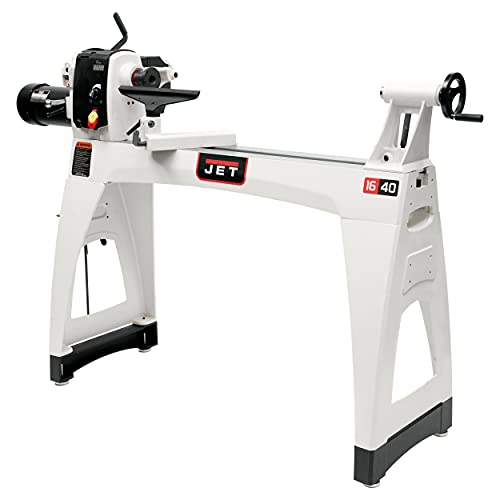
JET JWL-1640EVS 16 in. x 40 in. Electronic Variable Speed Wood Lathe
by JET
2. Laguna Revo 18|36: Best for Large Bowls
Who it's for: bowl turners who want 18-inch capacity, a VFD drive and the option to turn even bigger work outboard.
The Revo 18|36 is a long-running favorite with bowl turners. Laguna lists 18 inches of swing over the bed and 13-1/2 inches over the banjo, 36 inches between centers, and up to 32 inches of outboard swing with the optional 20-inch extension kit. An induction motor driven by a Delta variable frequency drive gives two ranges, 50 to 1,300 and 135 to 3,500 RPM, with forward, reverse and a digital readout.
You can buy it as a 1.5 HP 110V model or a 2 HP 220V model. It weighs 427 lb net, has 14/36/48 indexing positions and accepts Laguna's vacuum chuck system. The trade-off against JET and RIKON is Laguna's two-year warranty on new machines.
Pros
- 18-inch swing, 32-inch outboard with extension
- 50 RPM start, only two belt ranges
- Reverse and digital readout
- 110V or 220V versions
Cons
- Two-year warranty
- Outboard turning needs an accessory
- Heavy to move and set up
3. Powermatic 3520C: Best Premium
Who it's for: serious bowl turners who want maximum mass and the lowest speeds in a 20-inch lathe.
The 3520C is the lathe many clubs and professional turners measure others against. Powermatic lists 20 inches of swing and 36 inches between centers (35 inches in some listings), a 2 HP single-phase 220V motor, and two ranges from 15 to 1,200 and 40 to 3,200 RPM. It has 48 indexing positions and weighs 726 lb net.
That 15 RPM floor and the weight are what you pay for: a big, wet, out-of-balance blank stays calm at speeds where lighter lathes would walk. You need a 220V circuit and a floor that can take the load. Powermatic backs it for five years.
Pros
- 20-inch swing
- 15 RPM low end
- 726 lb of mass
- Five-year warranty
Cons
- Requires 220V
- Premium price tier
- Needs space and a strong floor
4. RIKON 70-1420VSR: Best Benchtop for Bowls
Who it's for: turners who need a benchtop lathe but want the most bowl capacity and power in that class.
RIKON pushes the midi format as far as it goes here: 14 inches of swing over the bed (10-5/8 inches over the tool rest) and 20 inches between centers, with a 1-1/2 HP motor on 115V. Three ranges cover 150 to 720, 550 to 1,650 and 1,300 to 3,850 RPM, forward and reverse.
Its biggest bowl advantage is the 1-1/4 in. x 8 TPI spindle, unusual on a benchtop lathe, which lets you use the same chucks as a full-size machine. The 150 RPM floor is higher than JET and Laguna's best, so true large blanks before you speed up. At 137 lb, put it on a stout stand and add weight. RIKON lists a five-year warranty.
Pros
- 14-inch swing on a benchtop
- Full-size 1-1/4 in. x 8 TPI spindle
- 1-1/2 HP with reverse
- Five-year warranty
Cons
- 150 RPM low end
- Belt changes between three ranges
- Needs a heavy stand for big blanks

RIKON 70-1420VSR 14 in. x 20 in. Midi VSR Lathe
by RIKON
Currently unavailable on Amazon
5. JET JWL-1221VS: Best Starter Lathe for Bowls
Who it's for: new turners who want to learn bowls on a midi lathe that also handles spindles and pens.
The JWL-1221VS is our top pick in several guides because it gets the bowl basics right. JET lists 12-1/2 inches of swing, 20-1/2 inches between centers, a 1 HP 115V motor and three ranges from 60 to 3,600 RPM, with reverse and a digital readout. It weighs about 121 lb.
That 60 RPM start is low for a midi, which makes a first bowl blank much less intimidating. Swing limits you to roughly 10- to 11-inch bowls in practice, which covers most first bowls. The 1 in. x 8 TPI spindle takes the widest range of chucks for midi lathes. JET's warranty is five years.
Pros
- 60 RPM start with reverse
- Digital readout
- Light enough for a bench, heavy enough for small bowls
- Five-year warranty
Cons
- 12-1/2-inch swing caps bowl size
- 1 HP limits heavy cuts
- Needs a stand and added mass for bigger blanks

JET JWL-1221VS 12 in. x 21 in. Variable Speed Wood Lathe
by JET
6. Laguna Revo 15|24: Best Step-Up on 110V
Who it's for: turners outgrowing a midi who want more swing and a 50 RPM start without wiring 220V.
Laguna positions the 15|24 between its 12|16 benchtop and 18|36 floor lathe. It runs a 1.5 HP permanent-magnet DC motor on 110V with PWM speed control, giving 50 to 650, 325 to 2,100 and 650 to 4,200 RPM across three ranges. Swing is 15-1/2 inches over the bed and 11-3/32 inches over the banjo, with 24 inches between centers and 25 inches outboard using an optional accessory.
It has a 1-1/4 in. x 8 TPI spindle, 24 indexing positions with a lock and 288 lb of net weight. For many hobby shops it is the right size: real bowl capacity without the floor space of a 40-inch bed.
Pros
- 50 RPM start on 110V
- 15-1/2-inch swing in a compact footprint
- Full-size spindle thread
- Optional outboard turning
Cons
- Two-year warranty
- Three belt ranges
- Outboard needs an accessory

7. RIKON 70-3040: Best for Platters and Huge Bowls
Who it's for: turners with space, 220V and ambitions for very large bowls and platters.
The 70-3040 is built around a motorized sliding bed that changes the distance between centers from 20 to 40 inches and the swing from about 23 to 31 inches. RIKON lists a 3 HP 220V motor with forward and reverse and three ranges of 20 to 650, 50 to 1,750 and 100 to 3,850 RPM. The 20 RPM floor is the lowest in RIKON's lineup.
It weighs 546 lb, has 36 indexing positions, a 1-1/4 in. x 8 TPI spindle and a magnetic-back control box that can sit anywhere along the bed. This is far more lathe than most hobbyists need, but nothing else here handles a 28-inch platter.
Pros
- Swing up to about 31 inches
- 20 RPM low end
- 3 HP with reverse
- Five-year warranty
Cons
- Requires 220V
- Very large and heavy
- Overkill for typical bowls

RIKON 70-3040 30 in. x 40 in. VSR Lathe with Sliding Bed
by RIKON
Currently unavailable on Amazon
Buying guide: choosing a lathe for bowl turning
Swing: what size lathe for bowl turning?
Swing is twice the distance from the spindle center to the bed. It sets the largest bowl you can mount, but the tool rest base (banjo) sits higher than the bed, so the swing over the banjo is the real limit for a full-height blank. Laguna publishes both numbers, which is helpful.
| Lathe class | Typical swing | Practical bowl size | Amazon |
|---|---|---|---|
| Mini | 10 in. | Small bowls, up to about 8 in. | See options |
| Midi | 12 to 14 in. | Up to about 10 to 12 in. | See options |
| Large benchtop or compact floor | 15 to 16 in. | Up to about 13 to 14 in. | See options |
| Floor lathe | 18 to 20 in. | Up to about 16 to 18 in. | See options |
Low speed matters more than top speed
The AAW warns that the old formula of diameter times RPM equals 6,000 to 9,000 can produce speeds that are too fast for bowls; it gives 1,000 to 1,500 RPM for a 6-inch blank as an example. Start every bowl blank at the lathe's lowest speed and increase only while it runs smoothly. A lathe that starts at 15 to 60 RPM gives you room to do that with big blanks; one that starts at 500 RPM does not. Our wood lathe speed chart explains the AAW's guidance.
Mass and motor
A heavy lathe absorbs the wobble of an unbalanced blank. Benchtop lathes in the 100 to 140 lb range need a stout stand and added weight; see our benchtop vs floor lathe comparison. For motors, 1 HP handles small and medium bowls with sensible cuts, while 1-1/2 to 3 HP lets you take heavier cuts in large blanks.
Spindle thread and chucks
Most bowl work happens in a four-jaw chuck. Midis usually have a 1 in. x 8 TPI spindle and full-size lathes 1-1/4 in. x 8 TPI. Buy the chuck to match your lathe's thread, or use an insert. Our wood lathe chuck guide compares the main options.
Reverse, indexing and outboard turning
Reverse helps sanding and some finishing cuts; lock the chuck to the spindle with its set screws before using it, as the AAW warns. Indexing helps with fluting and layout. Outboard turning or a sliding headstock lets you turn bowls bigger than the inboard swing, but it is a niche need.
Power supply
Lathes above 2 HP usually need 220V. The JET JWL-1640EVS, Laguna 15|24 and the 110V Laguna 18|36 run from household current, which keeps installation simple.
How we chose
We did not test these lathes ourselves. We compared the swing, speed range, motor, spindle and weight that JET, Laguna, Powermatic and RIKON publish for each model, cross-checked them against retailer listings, and weighed them against the AAW's guidance on safe bowl speeds. We favored low starting speeds and mass because those are what make bowl turning safer.
FAQ
What size lathe do I need for bowl turning?
The swing sets the largest bowl, and the swing over the tool rest base (banjo) is the practical limit for a full-height blank. A 12-inch midi such as the JET JWL-1221VS handles bowls up to about 10 to 11 inches in practice. For regular 12- to 16-inch bowls, look at 15- to 18-inch lathes such as the Laguna Revo 15|24 or JET JWL-1640EVS.
Can you turn bowls on a mini lathe?
Small ones, yes. A 10- or 12-inch lathe turns bowls up to roughly 8 to 10 inches if it has a low starting speed and enough mass. Lathes that start at 500 RPM or more are better kept to small, balanced blanks.
What speed should a lathe run for bowls?
Start at the lowest speed and increase only while the blank runs smoothly. The AAW warns that the old formula of diameter times RPM equals 6,000 to 9,000 can give speeds that are too fast for an unbalanced bowl blank, which is why a low minimum speed matters so much on a bowl lathe.
Do I need reverse on a lathe for bowl turning?
It is not essential, but it helps sanding and some finishing cuts. If you use reverse, lock the chuck or faceplate to the spindle with its set screws first; the AAW warns they can unscrew in reverse otherwise.
Is 1 HP enough for turning bowls?
For bowls up to about 10 or 11 inches on a 12-inch midi, 1 HP works if you take reasonable cuts. Larger, heavier and wetter blanks benefit from 1-1/2 to 2 HP and more lathe mass.
Verdict
The JET JWL-1640EVS is the best lathe for bowl turning for most home shops: 16-1/2 inches of swing, a 40 RPM start and real mass on 115V. Choose the Laguna Revo 18|36 for bigger bowls and outboard work, or start with the JET JWL-1221VS if you are learning. Then add a good bowl gouge and follow our step-by-step wood bowl turning guide.