We research products independently. When you buy through links on this page, we may earn a commission from Amazon at no extra cost to you. As an Amazon Associate we earn from qualifying purchases. Read our affiliate disclosure.
The short answer: a benchtop lathe is the right choice for pens, spindles, boxes, ornaments and bowls up to about 10 inches. A floor lathe is worth it when you regularly turn larger bowls, heavy green blanks from logs or long spindles, and when you have the space and, often, a 220V circuit. Most turners start on a benchtop midi, and many never need more.
What decides it is not the label but four numbers: swing, weight, low-end speed and distance between centers. This comparison uses real current models from JET, RIKON, Laguna and WEN to show what you gain and give up with each format.
Benchtop vs floor lathe at a glance
| Benchtop (mini and midi) | Floor lathe | |
|---|---|---|
| Typical swing | About 8 to 14 in. | About 16 to 24 in. or more |
| Typical weight | About 75 to 140 lb | About 290 to 600+ lb |
| Motor | About 1/2 to 1-1/2 HP | About 1-1/2 to 3 HP |
| Power | 120V household | 120V on some, 220V on many |
| Footprint | On a bench or stand | Dedicated floor space |
| Best for | Pens, spindles, boxes, small bowls | Large bowls, hollow forms, long spindles |
| Bed extension | Common option | Often built-in length |
| Cost tier | Budget to mid-range | Mid-range to premium |
| Amazon | See options | See options |
Real models compared
| Lathe | Format | Swing over bed | Between centers | Motor | Low speed | Weight | Amazon |
|---|---|---|---|---|---|---|---|
| WEN LA3421 | Mini benchtop | 8 in. | 13 in. | 3.2 A | 750 RPM | Light | Check price |
| JET JWL-1015VS | Mini benchtop | 10 in. | 15-1/2 in. | 1/2 HP | 200 RPM | ~78 lb shipping | Check price |
| JET JWL-1221VS | Midi benchtop | 12-1/2 in. | 20-1/2 in. | 1 HP | 60 RPM | 121 lb | Check price |
| RIKON 70-1420VSR | Midi benchtop | 14 in. | 20 in. | 1-1/2 HP | 150 RPM | 137 lb | See options |
| Laguna Revo 15|24 | Compact floor | 15-1/2 in. | 24 in. | 1.5 HP, 110V | 50 RPM | 288 lb | Check price |
| JET JWL-1640EVS | Floor | 16-1/2 in. | 40 in. | 1-1/2 HP, 115V input | 40 RPM | 377 lb | Check price |
| Laguna Revo 18|36 | Floor | 18 in. | 36 in. | 1.5 HP 110V or 2 HP 220V | 50 RPM | 427 lb | Check price |

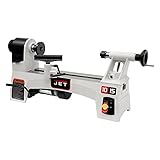


Specs are from each maker's or major retailers' published listings.
Which of these lathes fit your work?
Enter a size to filter the table above. Tap a column heading to sort.
Diameter is checked against swing over the bed, which is the maximum; the practical limit over the banjo is smaller. Length is checked against distance between centers. Figures come from the table above, so a lathe with an unlisted spec stays visible.
The differences, one by one
1. Swing and real bowl size
Swing over the bed is the headline number, but the tool rest base (banjo) takes up room, so the swing over the banjo is closer to your real limit. The RIKON 70-1420VSR, for example, swings 14 inches over the bed and 10-5/8 inches over the tool rest. On benchtop midis, plan on bowls of about 10 inches; on 16- to 18-inch floor lathes, about 13 to 16 inches.
2. Mass and vibration
Mass is what quiets an unbalanced blank. A 121 lb benchtop lathe can turn a 10-inch bowl smoothly if the blank is balanced and the bench is solid. A 400 lb floor lathe shrugs off a lumpy 14-inch log section. Benchtop owners can close some of the gap with a heavy bench or a stand loaded with sandbags.
3. Low-end speed
The American Association of Woodturners advises starting unbalanced work slowly and increasing speed only once it runs without vibration. Low starting speed used to be a floor-lathe advantage, but several benchtops now start very low: 60 RPM on the JET JWL-1221VS and 50 RPM on the Laguna Revo 12|16. Budget minis start much higher, such as 750 RPM on the WEN LA3421, which limits them to small, balanced work.
4. Power and electrical
Most benchtop lathes run on a standard 120V outlet. Floor lathes range from 110V models, like the Laguna Revo 15|24 and the 110V Revo 18|36, to 220V machines such as the 2 HP Revo 18|36 or the 3 HP Revo 24|36. Check your shop's circuits before you shop.
5. Length between centers
Benchtop lathes typically offer 13 to 20 inches between centers, which covers pens, handles, rolling pins and most furniture parts with a bed extension. Floor lathes commonly give 36 to 40 inches, enough for table legs and balusters without extensions.
6. Spindle height and ergonomics
A floor lathe puts the spindle at a fixed height set by its legs. A benchtop lathe's height depends on your bench or stand, which is an advantage: you can set it where it suits you. The AAW's rule of thumb is a spindle around the height of your heart and no lower than your elbow when you stand relaxed.
7. Spindle thread and accessories
Most benchtop lathes use a 1 in. x 8 TPI spindle; many floor lathes and the RIKON 70-1420VSR use 1-1/4 in. x 8 TPI. Moving up a size often means new chuck inserts.
8. Space and moving the lathe
A benchtop lathe can share a bench and be moved by two people. A floor lathe needs its own floor space with room to stand at the headstock and, on sliding-headstock models, at the outboard end. Plan a path through the door: a 400 lb crate does not take stairs well.
9. Upgrade path
A benchtop lathe rarely becomes useless after an upgrade. Many turners keep a mini or midi for pens, finials and small work after they buy a floor lathe, because swapping a large chuck for a pen mandrel on a big machine is a nuisance. If you think you will eventually want a floor lathe, buy a chuck with an insert system so it can move to a 1-1/4 in. x 8 TPI spindle later, and buy full-size tools that suit both machines.
Making a benchtop lathe work like a bigger one
You can close part of the gap between the two formats with a few inexpensive changes:
- Mass. Mount the lathe on a heavy stand and add a shelf of sandbags or concrete blocks low down. Weight at the base damps vibration far better than weight on top.
- Rigidity. Bolt the stand to the floor or a wall if it walks. Diagonal braces on a wooden bench help a lot.
- Balance the blank. Bandsaw bowl blanks round and remove bark and heavy sapwood before mounting, so less imbalance reaches the lathe.
- Bed extension. Most midi makers sell one, adding length for spindles without a new lathe.
- Low speed. If your benchtop starts at 250 RPM or more, keep bowl blanks smaller and better balanced.
None of this adds swing, though. If the blank does not fit over the banjo, it does not fit.
Choose a benchtop lathe if…
- You turn pens, ornaments, spindles, boxes and bowls up to about 10 inches
- You have limited space or share your shop with other tools
- You want 120V power and a lower cost of entry
- You are new to turning and want to learn before investing more
Start with our guides to the best mini wood lathes and best midi lathes.
Choose a floor lathe if…
- You regularly turn bowls over 12 inches or hollow forms
- You turn wet, heavy blanks straight from logs
- You need 36 to 40 inches between centers for legs and spindles
- You have the floor space and, for the largest machines, a 220V circuit
Our JET wood lathe review covers the JWL-1640EVS, and our Laguna lathe review compares every Revo floor model.
A note on benchtop metal lathes
Searches for "benchtop lathe" also turn up benchtop metal lathes. They are a different class of machine, with carriages, cross slides and lead screws. If you are choosing between the two, see wood lathe vs metal lathe.
Related: see our wood lathe stands guide.
FAQ
What is a benchtop lathe?
A benchtop lathe is a wood lathe small enough to sit on a workbench or a separate stand rather than on its own cast iron legs. The category includes mini lathes (about 8 to 10 inches of swing) and midi lathes (about 12 to 14 inches), typically weighing roughly 75 to 140 lb.
Can you turn bowls on a benchtop lathe?
Yes. Midi benchtop lathes with 12 to 14 inches of swing handle bowls up to roughly 10 inches comfortably, and lathes with a very low starting speed, such as the JET JWL-1221VS at 60 RPM or the Laguna Revo 12|16 at 50 RPM, make out-of-round blanks easier. Large, heavy green blanks are where floor lathes earn their keep.
Is a floor lathe worth it?
If you regularly turn bowls over about 12 inches, wet blanks from logs or long spindles, yes. Floor lathes add mass, swing, power and often a sliding headstock. If you mostly turn pens, spindles and small bowls, a good benchtop midi is the better value.
Can I put a benchtop lathe on a stand?
Yes, and most makers sell one. RIKON lists a universal stand (70-920) for its midi lathes, and JET and Laguna sell stands for their benchtop models. A stand puts the spindle at a better height and lets you add sandbags or a shelf of weight to damp vibration.
How heavy should a workbench be for a benchtop lathe?
Heavy and rigid. A benchtop lathe that weighs about 100 lb will still shake on a light bench with an unbalanced blank. Bolt the lathe down, keep the bench against a wall if you can, and add weight low on the base.
The bottom line
For most new and intermediate turners, a benchtop midi with a low starting speed, such as the JET JWL-1221VS, is the best balance of capacity, cost and space. Move to a floor lathe when your blanks regularly outgrow 10-inch bowls or when vibration, not skill, is what limits your work.