We research products independently. When you buy through links on this page, we may earn a commission from Amazon at no extra cost to you. As an Amazon Associate we earn from qualifying purchases. Read our affiliate disclosure.
A mini wood lathe turns pens, bottle stoppers, ornaments, tool handles, boxes and small bowls on a bench in a spare room or a corner of the garage. The catch is that "mini" covers everything from 8-inch hobby machines to 12-inch midis that weigh over 100 lb. Those are very different tools.
What separates a good small lathe from a frustrating one is a low starting speed, standard tapers and spindle threads so accessories fit, and enough mass to stay put. Here are the best mini and benchtop lathes currently sold in the US, with specs verified from manufacturer and retailer listings.
Our top picks at a glance
Quick picks
- Best Overall Mini: JET JWL-1015VS. Best for a true mini with a 200 RPM start and a five-year warranty.
- Best Budget: WEN LA3421. Best for pens and small spindles on the smallest budget.
- Best Budget 12-Inch: WEN LA3424. Best for more capacity than a mini without leaving the budget tier.
- Best for Pens & Small Work: NOVA Comet II DR. Best for 4,000 RPM, reverse and a compact frame.
- Best Low-Speed Torque: Laguna Revo 12|16. Best for bowls on a benchtop, with a 50 RPM low end.
- Best Value Benchtop Kit: RIKON 70-1516VSRK. Best for a 12-inch benchtop lathe that comes with a four-jaw chuck.
- Best Big Benchtop: JET JWL-1221VS. Best for buying once: 1 HP, 60 RPM start and reverse.
Comparison table
| Lathe | Best for | Swing | Between centers | Motor | Speed range | Tapers | Amazon |
|---|---|---|---|---|---|---|---|
| JET JWL-1015VS | True mini | 10 in. | 15-1/2 in. | 1/2 HP | 200–3,600 RPM (3 ranges) | MT2 / MT2 | Check price |
| WEN LA3421 | Smallest budget | 8 in. | 13 in. | 3.2 amp | 750–3,200 RPM | MT1 / MT1 | Check price |
| WEN LA3424 | Budget 12-inch | 12 in. (workpiece) | 18 in. (workpiece) | 4.5 amp | 520–3,400 RPM (5 steps) | MT2 / MT2 | Check price |
| NOVA Comet II DR | Pens, small work | 12 in. | 16-1/2 in. | 3/4 HP | 250–4,000 RPM | MT2 tailstock | Check price |
| Laguna Revo 12|16 | Bowls on a bench | 12-1/2 in. | 15-1/2 in. | 1 HP DC | 50–3,500 RPM (3 ranges) | MT2 / MT2 | Check price |
| RIKON 70-1516VSRK | Value kit | 12 in. | 16-1/2 in. | 1-1/4 HP | 250–3,200 RPM (3 ranges) | MT2 / MT2 | See options |
| JET JWL-1221VS | Buy-once benchtop | 12-1/2 in. | 20-1/2 in. | 1 HP | 60–3,600 RPM (3 ranges) | MT2 / MT2 | Check price |



Which of these lathes fit your work?
Enter a size to filter the table above. Tap a column heading to sort.
Diameter is checked against swing over the bed, which is the maximum; the practical limit over the banjo is smaller. Length is checked against distance between centers. Figures come from the table above, so a lathe with an unlisted spec stays visible.
The best mini wood lathes, reviewed
1. JET JWL-1015VS: Best Overall Mini
Who it's for: pen turners, ornament makers and beginners who want a genuinely small lathe that does not cut corners.
The 1015VS is a 10-inch swing, 15-1/2-inch-between-centers machine with a 1/2 HP, 115V motor that JET rates at 4 amps. Speed is variable within three belt ranges (200–1,050, 300–1,750 and 600–3,600 RPM), so you can start balanced work slowly and still reach pen-turning speeds. The bed is cast iron, it has 24 indexing positions, and both the spindle and the tailstock quill take MT2, the most common taper on woodturning lathes. It ships with a live center and weighs about 78 lb boxed.
JET backs its woodworking machines with a five-year warranty, which is unusual at this size. The 1/2 HP motor is the limit: it is happiest on spindles and bowls of 6 to 7 inches, not on 10-inch blanks of wet oak.
Pros
- 200 RPM low end on a true mini lathe
- MT2 tapers fit most pen mandrels and centers
- 24-position indexing and cast iron bed
- Five-year warranty
Cons
- 1/2 HP motor is modest for bowls near full swing
- Belt changes between the three ranges
- 15-1/2 inches between centers limits long spindles
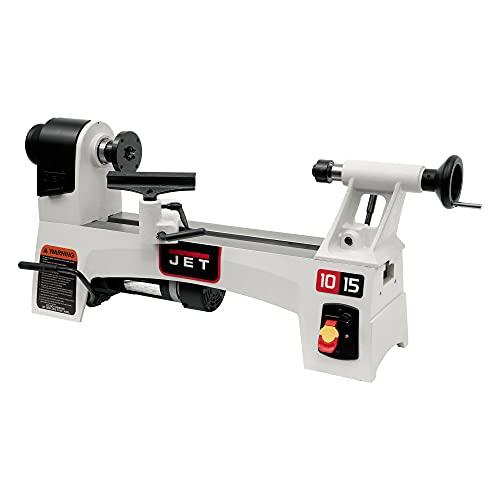
JET JWL-1015VS 10 in. x 15 in. Variable Speed Wood Lathe
by JET
2. WEN LA3421: Best Budget
Who it's for: someone who wants to try pens, spindles and small gifts before spending real money.
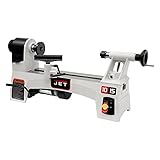
WEN's current listing for the LA3421 gives an 8-inch swing and 13 inches between centers (older listings say 12). A 3.2-amp motor with a soft start drives variable speed from 750 to 3,200 RPM, adjusted with a dial, so there are no belts to move. It comes with two tool rests (4-1/2 and 7 inches), a 2.3-inch faceplate, a spur center, a cup center and a knockout rod, and WEN's chuck listings show it takes 1 in. x 8 TPI accessories.
Two trade-offs matter. The tapers are MT1, not MT2, so check that any mandrel or live center you buy is MT1 or use an adapter. And 750 RPM is too fast to start anything large or out of balance. WEN itself recommends a 4-inch maximum workpiece when you use its 4-inch chuck on this lathe. Treat it as a pen and spindle machine and it makes sense.
Pros
- Dial-controlled variable speed with no belt changes
- Two tool rests and a faceplate included
- Light and easy to store
- 1 in. x 8 TPI accessories fit
Cons
- MT1 tapers limit accessory choice
- 750 RPM minimum is too fast for bowls of any size
- Two-year warranty

WEN LA3421 3.2-Amp 8-Inch by 13-Inch Variable Speed Mini Benchtop Wood Lathe
by WEN
3. WEN LA3424: Best Budget 12-Inch
Who it's for: budget buyers who want room for small bowls and longer spindles.
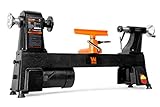
The LA3424 (sold with a stand as the 3424T) handles workpieces up to 12 inches wide and 18 inches long. A 4.5-amp motor runs five belt speeds: 520, 900, 1,400, 2,150 and 3,400 RPM. Unlike the LA3421, it uses MT2 in both headstock and tailstock, and WEN lists it as compatible with its 1 in. x 8 TPI chucks. A 3-1/8-inch faceplate, centers and an accessory holder are included.
The five fixed speeds mean stopping to move the belt, and 520 RPM is still a brisk start for a lumpy bowl blank. For spindles, boxes and bowls up to about 8 inches it is a lot of lathe for the money.
Pros
- 12 x 18-inch capacity in the budget tier
- MT2 tapers
- Faceplate and accessory holder included
- Simple step-pulley drive
Cons
- Speeds change by moving the belt
- 520 RPM minimum
- Light 70 lb build for its swing

WEN LA3424 4.5-Amp 12-Inch by 18-Inch 5-Speed Benchtop Wood Lathe
by WEN
4. NOVA Comet II DR: Best for Pens & Small Work
Who it's for: pen, finial and box turners who want electronic speed control and reverse in a compact frame.
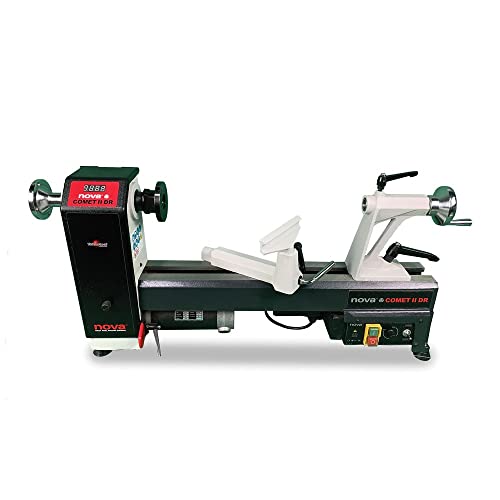
The Comet II has a 3/4 HP motor with electronic variable speed from 250 to 4,000 RPM, a digital readout and a forward/reverse switch. Capacity is 12 inches of swing and 16-1/2 inches between centers, with an optional bed extension to 42 inches. The tailstock is a hollow MT2, which lets you drill through for lamps, and the spindle is 1 in. x 8 TPI.
That 4,000 RPM top speed is the highest here and it helps pens and small spindles finish cleanly off the tool. At about 77 lb shipping weight it is easy to move, though that also means less mass for bigger bowls.
Pros
- 250–4,000 RPM electronic speed with digital readout
- Forward/reverse for sanding
- Hollow MT2 tailstock
- Bed extension available
Cons
- 3/4 HP limits heavy bowl roughing
- 16-1/2 inches between centers out of the box
- Light frame needs a solid bench
5. Laguna Revo 12|16: Best Low-Speed Torque
Who it's for: turners who mainly want small bowls and like the idea of outboard turning on a benchtop machine.
Laguna's Revo 12|16 uses a 1 HP DC permanent-magnet motor with a pulse width modulation controller, which Laguna says keeps torque steady across the speed range. Three belt ranges cover 50–525, 325–1,750 and 650–3,500 RPM, and that 50 RPM floor is the lowest in this list. Swing is 12-1/2 inches over the bed and 9-1/2 inches over the banjo, with up to 16 inches outboard. Distance between centers is 15-1/2 inches, and Laguna sells 10-inch and 20-inch bed extensions.
The spindle is 1 in. x 8 TPI at both ends with a 3/8-inch bore, the tailstock is MT2, and there are 24 indexing positions. Net weight is 118 lb, solid for a benchtop machine.
Pros
- 50 RPM low end with a torque-holding PWM controller
- Outboard turning up to 16 inches
- 118 lb of mass
- 24-position indexing
Cons
- 15-1/2 inches between centers is short without an extension
- Belt changes between ranges
- Laguna's spec page does not list reverse

6. RIKON 70-1516VSRK: Best Value Benchtop Kit
Who it's for: buyers stepping up from a mini who want bowl-ready work-holding in the box.
RIKON's spec page lists 12 inches of swing (9-1/4 inches over the tool rest), 16-1/2 inches between centers and a 1-1/4 HP brushless DC motor on 120V, with three belt ranges (250–850, 430–1,450 and 950–3,200 RPM), forward and reverse, a digital readout and 24 indexing positions. The spindle is 1 in. x 8 TPI with MT2 head and tail, it weighs 99 lb, and the warranty is five years. The "K" means kit: it ships with RIKON's Z3 four-jaw chuck and 2-inch jaws, spur and live centers, a 3-inch faceplate and a 6-inch tool rest on a 1-inch post. A 13-1/2-inch bed extension (70-903) is available.
You give up the JET 1221VS's 60 RPM low end and some length: 250 RPM is fine for spindles and balanced bowls, less so for rough green blanks.
Pros
- Four-jaw chuck, faceplate and centers included
- Brushless motor with reverse and readout
- Standard spindle and tapers
- Five-year warranty
Cons
- 250 RPM minimum
- 16-1/2 inches between centers without the extension
- Belt changes between ranges

RIKON 70-1516VSRK 12 in. x 16-1/2 in. VSRK Midi Lathe with Z3 Chuck System
by RIKON
Currently unavailable on Amazon
7. JET JWL-1221VS: Best Big Benchtop
Who it's for: anyone who suspects a mini will be outgrown within a year.
Technically a midi, the 1221VS still sits on a bench, and it is the most complete machine here. It has a 1 HP motor, a 60 to 3,600 RPM range in three belt positions, forward/reverse, a digital readout and 24 indexing positions. Retail spec sheets list 12-1/2 inches of swing and 20-1/2 inches between centers, with a bed extension to about 43 inches. The spindle is 1 in. x 8 TPI and both ends are MT2.
At about 121 lb it is not something you move every weekend. If you have the bench for it, though, it removes most reasons to upgrade. Our full JET wood lathe review compares it with the larger 1440VSK.
Pros
- 60 RPM minimum for safe starts
- Forward/reverse and digital readout
- Bed extension to about 43 inches
- Five-year JET warranty
Cons
- Heaviest machine here
- Belt changes between ranges
- Stand sold separately

JET JWL-1221VS 12 in. x 21 in. Variable Speed Wood Lathe
by JET
Buying guide: choosing a mini wood lathe
Mini, midi or benchtop: what the labels mean
No industry standard defines these terms. As a working rule, a mini lathe swings 8 to 10 inches with 12 to 15 inches between centers, and a midi lathe swings around 12 inches with 16 to 21 inches between centers and a 3/4 to 1 HP motor. "Benchtop" only means it needs a bench or stand. If you think you will turn bowls over 8 inches, go straight to a midi. Our midi wood lathe guide covers that class in more depth.
Real capacity versus rated swing
Rated swing is measured over the bed. The tool rest base sits higher, so your practical limit for shaping the outside of a bowl is closer to the "swing over banjo" figure where one is published (9-1/2 inches on the 12-1/2-inch Laguna, for example). Plan bowls about 2 inches smaller than rated swing.
Speed control and the low end
This is where small lathes differ most. Step-pulley machines like the WEN LA3424 have a handful of fixed speeds. Electronic variable speed lets you dial in speed while the lathe runs. The low end is the safety number. The AAW's Safety Guidebook for Woodturners suggests about 3,000 RPM for spindle stock 1 inch or less, 2,000 RPM at 2 inches, 1,500 at 3 inches and 1,000 RPM or less at 4 inches and up, and it advises starting unbalanced work below those figures. A lathe that cannot go below 750 RPM is fine for pens and spindles but not for bowls.
Morse taper and spindle thread
MT2 is the most common taper on woodturning lathes, according to the AAW, and almost every pen mandrel, live center and drill chuck is made in MT2. The WEN LA3421's MT1 is the outlier here. For spindle threads, 1 in. x 8 TPI is the small-lathe standard and fits a huge range of chucks and faceplates.
Mass and mounting
Light lathes vibrate. Bolt a mini lathe to a heavy bench, or build a stand with a shelf you can load with sandbags. The AAW's rule of thumb puts the spindle near the height of your heart and no lower than your elbow. A low bench is the most common ergonomic mistake with benchtop lathes.
Warranty and parts
JET's five-year warranty stands out at this size. WEN offers two years. Belts, tool rests and live centers are wear items, so pick a brand with US parts support. If you are weighing a Harbor Freight Central Machinery lathe instead, see our Harbor Freight mini lathe comparison. For VEVOR's benchtop models, read our take on the VEVOR mini lathe.
What to turn first
Mini lathes shine on pens, so look at our woodturning pen kits guide, then our list of wood lathe projects for beginner-sized ideas.
How we chose
We did not test these lathes in a lab or a shop. We compared manufacturer spec sheets and current retailer listings, checked which models are actually sold in the US today, and weighed them against the AAW's safety and lathe-buying guidance. Low-end speed, standard tapers, warranty length and parts support counted most. Where retailer specs disagreed, we say so or leave the spec out.
FAQ
What is the difference between a mini lathe and a midi lathe?
There is no formal standard. In practice, mini lathes swing about 8 to 10 inches with 12 to 15 inches between centers, while midi lathes swing about 12 inches with 16 to 21 inches between centers and usually have a 3/4 to 1 HP motor. Both sit on a bench.
Can you turn bowls on a mini wood lathe?
Yes, small ones. Allow for the tool rest base and you can turn bowls a couple of inches smaller than the rated swing. Keep blanks dry, sound and balanced, and use the lowest speed your lathe offers to start.
Is a mini lathe good for pen turning?
A mini lathe is ideal for pens. Pen blanks are under an inch in diameter and a few inches long, and they turn best at high speed. Look for a top speed of 3,000 RPM or more and an MT2 headstock, which fits most pen mandrels.
What is the best small wood lathe for a beginner?
The JET JWL-1015VS is the safest all-round choice thanks to its 200 RPM low end, MT2 tapers and five-year warranty. On a tight budget, the WEN LA3421 is a reasonable way to start with spindles and pens. For more options, see our best wood lathes for beginners.
How much space does a benchtop wood lathe need?
A 10 x 15-inch mini lathe like the JET JWL-1015VS is about 30 inches long. A 12 x 21-inch midi is closer to 34 inches. Add room to stand at the front, plus clearance at the headstock end for a handwheel and at the tailstock end for removing centers.
Verdict
The JET JWL-1015VS is the best mini wood lathe for most people: a real 200 RPM start, MT2 tapers and a five-year warranty in a 10-inch frame. If you only plan to turn pens, the WEN LA3421 will do the job on a budget. If bowls are on your list, skip the true minis and buy a 1 HP benchtop midi like the Laguna Revo 12|16 or JET JWL-1221VS. For full-size options, see our best wood lathe guide.
Related guides: WEN lathe review and wood lathe stands.