We research products independently. When you buy through links on this page, we may earn a commission from Amazon at no extra cost to you. As an Amazon Associate we earn from qualifying purchases. Read our affiliate disclosure.
A midi wood lathe is the sweet spot for most home shops. It is big enough for bowls up to about 10 inches, long enough for tool handles and candlesticks, and small enough to live on a bench and run on a household outlet. It also takes the same standard chucks and centers as larger lathes.
What separates good midi lathes from frustrating ones is the low end of the speed range, the power and mass to keep a bowl blank steady, and the spindle thread, which decides which chucks fit. Below are seven current models with variable speed, from budget to premium. Every spec comes from the manufacturer's page or, where noted, from retailer listings.
Our top picks at a glance

Quick picks
- Best Overall Midi: JET JWL-1221VS. Best for a 60 RPM start, 1 HP and 20-1/2 inches between centers.
- Most Power and Swing: RIKON 70-1420VSR. Best for 14 inches of swing and a 1-1/2 HP motor on 115V.
- Best Premium Midi: Powermatic PM2014B. Best for a 15 RPM start and a sliding headstock on 120V power.
- Best for Small Bowls: Laguna Revo 12|16. Best for a 50 RPM floor and outboard turning up to 16 inches.
- Best Midi Bundle: RIKON 70-1516VSRK. Best for a midi that ships with a four-jaw chuck, faceplate and centers.
- Best Compact Midi: NOVA Comet II DR. Best for 4,000 RPM, reverse and a small footprint.
- Best Budget Midi: WEN 34035 + LA4444 Chuck Bundle. Best for a 14 x 20-inch work envelope at the lowest price.
Comparison table
| Lathe | Best for | Swing | Between centers | Motor | Speed range | Spindle thread | Weight | Amazon |
|---|---|---|---|---|---|---|---|---|
| JET JWL-1221VS | Overall | 12-1/2 in. | 20-1/2 in. | 1 HP | 60–3,600 RPM (3 ranges) | 1 in. x 8 TPI | about 121 lb | Check price |
| RIKON 70-1420VSR | Power and swing | 14 in. | 20 in. | 1-1/2 HP DC | 150–3,850 RPM (3 ranges) | 1-1/4 in. x 8 TPI | 137 lb | See options |
| Powermatic PM2014B | Premium | 14-1/4 in. | 19-1/4 in. | 1 HP VFD | 15–3,600 RPM (3 ranges) | 8 TPI (diameter not stated) | 172 lb | Check price |
| Laguna Revo 12|16 | Small bowls | 12-1/2 in. | 15-1/2 in. | 1 HP DC | 50–3,500 RPM (3 ranges) | 1 in. x 8 TPI | 118 lb | Check price |
| RIKON 70-1516VSRK | Bundle | 12 in. | 16-1/2 in. | 1-1/4 HP DC brushless | 250–3,200 RPM (3 ranges) | 1 in. x 8 TPI | 99 lb | See options |
| NOVA Comet II DR | Compact | 12 in. | 16-1/2 in. | 3/4 HP | 250–4,000 RPM | 1 in. x 8 TPI | about 77 lb shipping | Check price |
| WEN 34035 + LA4444 chuck | Budget | 14 in. (workpiece) | 20 in. (workpiece) | 6 A | 250–3,550 RPM | 1 in. x 8 TPI | 120-plus lb (per WEN) | Check price |


Which of these lathes fit your work?
Enter a size to filter the table above. Tap a column heading to sort.
Diameter is checked against swing over the bed, which is the maximum; the practical limit over the banjo is smaller. Length is checked against distance between centers. Figures come from the table above, so a lathe with an unlisted spec stays visible.
The best midi lathes, reviewed
1. JET JWL-1221VS: Best Overall Midi
Who it's for: most turners buying one benchtop lathe to learn on and keep.
The 1221VS does the important things well. Its 1 HP motor covers 60 to 3,600 RPM across three belt positions (60–900, 110–1,800 and 220–3,600 RPM), so you can start a lopsided blank barely turning and still reach pen speeds. JET lists forward and reverse, a digital readout and 24 indexing positions. Capacity is 12-1/2 inches of swing and 20-1/2 inches between centers, with a 22-1/2-inch bed extension available for spindles up to about 43 inches.
The spindle is 1 in. x 8 TPI with MT2 tapers at both ends, so it accepts almost every midi chuck and center sold. Our JET wood lathe review goes deeper on this model.
Pros
- 60 RPM low end for safe bowl starts
- Reverse, digital readout and 24-position indexing
- Long 20-1/2 inches between centers for a midi
- Bed extension available
Cons
- Belt changes for big speed jumps
- 12-1/2-inch swing limits bowl size
- Stand sold separately

JET JWL-1221VS 12 in. x 21 in. Variable Speed Wood Lathe
by JET
2. RIKON 70-1420VSR: Most Power and Swing
Who it's for: bowl turners who want 14 inches of swing without moving to a floor lathe.
RIKON's 70-1420VSR pushes the midi format to its limit. It offers 14 inches of swing over the bed (10-5/8 inches over the tool rest) and 20 inches between centers, driven by a 1-1/2 HP TEFC DC motor on 115V that draws 13 amps. Three variable ranges cover 150–720, 550–1,650 and 1,300–3,850 RPM, and the lathe runs forward and reverse.
Unlike most midis, it uses a 1-1/4 in. x 8 TPI spindle, the full-size standard, with MT2 in both headstock and tailstock. It has 24 indexing positions, a magnetic-backed control box, a pivoting belt cover and an 8-inch tool rest with a hardened steel top rod. RIKON lists the weight at 137 lb and backs it for five years.
Pros
- 14-inch swing and the most powerful motor here
- Full-size 1-1/4 in. x 8 TPI spindle
- Forward and reverse with magnetic control box
- Five-year warranty
Cons
- 150 RPM minimum is higher than JET or Powermatic
- 13-amp draw; a dedicated circuit helps
- New chuck insert needed if you own 1 in. x 8 TPI chucks

RIKON 70-1420VSR 14 in. x 20 in. Midi VSR Lathe
by RIKON
Currently unavailable on Amazon
RIKON sells the 70-1420VSR mainly through woodworking dealers, and its Amazon listing was showing as currently unavailable when we checked. If you want a 14 x 20-inch envelope you can order on Amazon today, the WEN 34035 bundle (pick 7 below) is the budget alternative, with far less power and a 1 in. x 8 TPI spindle.
3. Powermatic PM2014B: Best Premium Midi
Who it's for: turners who want premium build and the lowest possible starting speed on a benchtop lathe.
Powermatic launched the PM2014B in 2026 as its benchtop lathe. It offers 14-1/4 inches of swing and 19-1/4 inches between centers, with a 1 HP inverter-driven three-phase motor that runs on 120V input. The three ranges (15–900, 30–1,800 and 60–3,600 RPM) give it the lowest start of any lathe in this list.
It also has features you rarely see on a benchtop machine: a sliding headstock for outboard turning, a movable magnetic control box with digital readout, 24 indexing positions and a hardened steel top-rod tool rest. A stand and a 13-inch bed extension are available. Powermatic lists 172 lb net and a five-year warranty. Its page lists 8 TPI for the spindle without the diameter, and retailers list the previous PM2014 at 1-1/4 in. x 8 TPI, so confirm before ordering a chuck. See our Powermatic wood lathe review.
Pros
- 15 RPM low end
- Sliding headstock for outboard work
- Inverter drive on a 120V outlet
- Five-year warranty
Cons
- Premium price tier for a benchtop lathe
- Spindle thread diameter not stated by Powermatic
- Stand and extension extra on the benchtop version

Powermatic PM2014B 14 in. x 20 in. Variable Speed Woodworking Benchtop Lathe
by Powermatic
4. Laguna Revo 12|16: Best for Small Bowls
Who it's for: turners who mostly make bowls and boxes and want a slow, torquey start.
Laguna's Revo 12|16 pairs a 1 HP DC permanent-magnet motor with a pulse width modulation controller, which Laguna says holds torque steady across the range. Three belt ranges cover 50–525, 325–1,750 and 650–3,500 RPM. Swing is 12-1/2 inches over the bed and 9-1/2 inches over the banjo, and you can turn up to 16 inches outboard.
Between centers is the weak point at 15-1/2 inches, though Laguna sells 10- and 20-inch bed extensions. The spindle is 1 in. x 8 TPI at both ends with a 3/8-inch bore, the tailstock takes MT2, there are 24 indexing positions, and the net weight is 118 lb.
Pros
- 50 RPM low end with a torque-holding controller
- Outboard turning up to 16 inches
- 118 lb for a steady bench lathe
- Two bed extension lengths available
Cons
- Only 15-1/2 inches between centers
- Belt changes between ranges
- Laguna's spec page does not list reverse
5. RIKON 70-1516VSRK: Best Midi Bundle
Who it's for: new turners who want a lathe and the work-holding to start bowls in one box.
The "K" in 70-1516VSRK is the kit. RIKON ships it with its Z3 four-jaw chuck system and 2-inch (50 mm) jaws, a spur center, a live center, a 3-inch faceplate, a 6-inch tool rest with a 1-inch post, knockout bars, wrenches and a tool holder. RIKON describes the Z3 as a geared, self-centering four-jaw chuck with a direct 1 in. x 8 TPI thread.
The lathe itself has 12 inches of swing (9-1/4 inches over the rest) and 16-1/2 inches between centers, with a 1-1/4 HP brushless DC motor on 120V. Ranges are 250–850, 430–1,450 and 950–3,200 RPM, with forward and reverse, a digital readout and 24 indexing positions. It weighs 99 lb and carries a five-year warranty. A 13-1/2-inch bed extension (70-903) adds length and allows outboard turning up to 15 inches.
Pros
- Four-jaw chuck, faceplate and centers included
- Brushless DC motor with reverse and readout
- 1-inch tool rest post accepts many aftermarket rests
- Five-year warranty
Cons
- 250 RPM minimum is high for lumpy bowl blanks
- 16-1/2 inches between centers
- Lightest lathe here except the NOVA

RIKON 70-1516VSRK 12 in. x 16-1/2 in. VSRK Midi Lathe with Z3 Chuck System
by RIKON
Currently unavailable on Amazon
6. NOVA Comet II DR: Best Compact Midi
Who it's for: pen turners, box makers and anyone short on bench space.
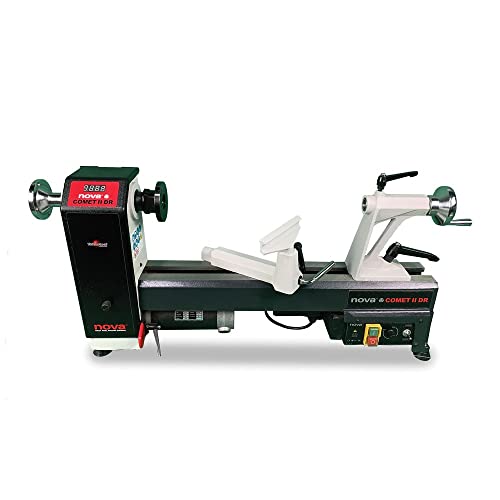
The Comet II uses a 3/4 HP motor with electronic variable speed from 250 to 4,000 RPM, a digital readout and a forward/reverse switch. That 4,000 RPM top speed is the highest here and suits pens and finials. Capacity is 12 inches over the bed and 16-1/2 inches between centers, and NOVA sells a bed extension that takes it to 42 inches.
The spindle is 1 in. x 8 TPI and the tailstock is a hollow MT2, so you can drill straight through the tailstock for lamps. At about 77 lb shipping weight it is the lightest midi in this list, which is great for portability and less great for large bowls.
Pros
- Highest top speed in this list
- Electronic speed, reverse and readout
- Compact and portable
- Bed extension to 42 inches
Cons
- 3/4 HP is the smallest motor here
- Light weight transmits vibration on big blanks
- 250 RPM minimum
7. WEN 34035 + LA4444 Chuck Bundle: Best Budget Midi
Who it's for: budget buyers who want a 14-inch work envelope and variable speed.
WEN rates the 34035 for workpieces up to 14 inches wide and 20 inches long. A 6-amp motor drives variable speed from 250 to 3,550 RPM, and the spindle is 1 in. x 8 TPI with MT2 tapers. The box includes an MT2 spur center, an MT2 live center, an 8-inch tool rest and a 4-inch faceplate. WEN describes it as a 120-plus-pound build with a two-year warranty. On Amazon the 34035 is sold as a bundle with WEN's LA4444 4-inch four-jaw self-centering chuck (1 in. x 8 TPI, with a screw chuck), so a starter chuck comes in the same order.
WEN does not publish a horsepower figure, and its 14-inch rating is a maximum workpiece size, not a comfortable bowl size. It is still the least expensive way into a 14-inch-class midi with variable speed.
Pros
- 14 x 20-inch work envelope
- Variable speed down to 250 RPM
- Centers, rest and faceplate included
- Bundled with a 4-inch four-jaw chuck
- Standard 1 in. x 8 TPI spindle
Cons
- No published horsepower
- Two-year warranty
- 14-inch rating is a maximum, not a working size

WEN 34035 6-Amp 14-Inch by 20-Inch Variable Speed Benchtop Wood Lathe & LA4444 4-Inch 4-Jaw Self-Centering Chuck Set
by WEN
Buying guide: how to choose a midi wood lathe
Midi, mini or full-size?
Minis usually offer 8 to 10 inches of swing and suit pens and small spindles; see our best mini wood lathes. Full-size floor lathes start around 16 inches of swing and weigh several hundred pounds; see our best wood lathe roundup. Midis sit between, with 12 to 14 inches of swing. If bowls under 10 inches and spindles under 20 inches cover most of what you want to make, a midi is the right size.
Variable speed and the low end
All seven lathes here have variable speed, but their minimums range from 15 to 250 RPM. That matters. The AAW's Safety Guidebook for Woodturners warns that the old bowl-speed formula can allow speeds that are too fast for unbalanced blanks, and says to start well below it and increase only when the work runs without vibration. A 15 to 60 RPM start gives you far more room to do that than 250 RPM.
Most midis combine variable speed with two or three belt ranges. You move the belt for large changes and turn a dial for fine control. The AAW notes that Reeves drives, an older variable-speed design, typically cannot go below about 400 RPM.
Swing over the bed vs over the rest
Swing over the bed is the headline number, but the tool rest base sits under the work. RIKON lists 10-5/8 inches over the rest on the 70-1420VSR and 9-1/4 inches on the 70-1516VSRK, and Laguna lists 9-1/2 inches over the banjo on the Revo 12|16. Those smaller numbers are the honest outside-turning limits.
Spindle thread
Most midis use 1 in. x 8 TPI. The RIKON 70-1420VSR uses 1-1/4 in. x 8 TPI, the full-size thread. If you plan to upgrade later, a chuck with replaceable inserts lets you move it to the next lathe; see our best wood lathe chucks.
Power, weight and stand
Power ranges from 3/4 HP to 1-1/2 HP here. Weight matters as much, since mass dampens vibration. On any benchtop lathe, the stand or bench is part of the machine: make it rigid, bolt the lathe down and set spindle height to the AAW's rule of thumb, around the height of your heart and no lower than your elbow.
Bed extensions
Most midis accept extensions for longer spindles. The AAW's buying guide points out that extensions are inexpensive compared with buying a lathe with a long one-piece bed. Check that an extension exists for the model before you buy, if table legs are on your list.
Reverse and readout
Reverse helps with sanding, and a digital readout lets you return to a known speed. The AAW warns that a chuck or faceplate can unscrew in reverse unless locked with set screws, so start reverse at low speed.
A note on the RIKON 70-220VSR
RIKON's long-running 70-220VSR did not appear on RIKON's current lathe page when we checked, and its product page no longer loads. RIKON's current midis are the 70-1420VSR and 70-1516VSRK. If you find a 70-220VSR at a retailer, confirm parts availability.
Price tiers
- Budget: WEN 34035.
- Mid-range: JET JWL-1221VS, RIKON 70-1516VSRK, NOVA Comet II DR.
- Upper mid-range: RIKON 70-1420VSR, Laguna Revo 12|16.
- Premium: Powermatic PM2014B.
New to turning? Our best wood lathes for beginners guide and parts of a wood lathe diagram will help you read the spec sheets.
How we chose
We did not test these lathes ourselves. We compared manufacturer spec pages from JET, RIKON, Powermatic, Laguna, Teknatool NOVA and WEN, checked them against retailer listings, and weighed them against the AAW's safety and lathe-buying guidance. We favored lathes with variable speed, a low starting speed, standard spindle threads and MT2 tapers, and brands with US parts support. Where a maker leaves out a spec, we say so.
FAQ
What is a midi wood lathe?
A midi lathe is a benchtop lathe between a mini and a full-size floor lathe, usually with 12 to 14 inches of swing and 16 to 21 inches between centers. Most use a 1 in. x 8 TPI or 1-1/4 in. x 8 TPI spindle, MT2 tapers and a 3/4 to 1.5 HP motor, and many accept bed extensions.
What is the best midi lathe for bowls?
Look for a low starting speed and enough mass. The Powermatic PM2014B starts at 15 RPM, the Laguna Revo 12|16 at 50 RPM and the JET JWL-1221VS at 60 RPM. For bowls over about 10 inches, the 14-inch RIKON 70-1420VSR or PM2014B give more room.
Is variable speed worth it on a wood lathe?
Yes. Variable speed lets you start an unbalanced blank slowly and bring it up only once it runs smoothly, which is the approach the AAW recommends. Step-pulley lathes force you to stop and move a belt, and their lowest speed is often too fast for rough bowl blanks.
Can a midi lathe turn table legs?
Not out of the box on most models, since 16 to 21 inches between centers is short for legs. Many midi lathes accept bed extensions: Powermatic lists a 13-inch extension for the PM2014B, RIKON a 13-1/2-inch extension for the 70-1516VSRK, and JET a 22-1/2-inch extension for the 1221VS.
Is a 1 HP midi lathe enough?
For spindles, pens, boxes and bowls up to about 10 inches, yes. Larger, heavier blanks need more mass as much as more power, which is when a 14-inch midi or a full-size floor lathe makes sense.
Verdict
The JET JWL-1221VS is the best midi wood lathe for most people: a 60 RPM start, 1 HP, reverse and 20-1/2 inches between centers. If you want more swing and power, the RIKON 70-1420VSR gives you 14 inches and 1-1/2 HP, and the Powermatic PM2014B adds a 15 RPM start and sliding headstock at a premium. On a budget, the WEN 34035 covers a 14 x 20-inch envelope with variable speed.
Related: see our NOVA lathe review.