We research products independently. When you buy through links on this page, we may earn a commission from Amazon at no extra cost to you. As an Amazon Associate we earn from qualifying purchases. Read our affiliate disclosure.
The best wood lathe for beginners is not the cheapest one or the biggest. It is the one that makes safe habits easy: a slow starting speed, a standard spindle and tapers so accessories just fit, enough mass to stay quiet, and a warranty that covers the inevitable early mistakes.
Most beginners also underestimate what they will want to make. Pens and tool handles come first, then a bowl, and then you want a bigger bowl. That pushes our top recommendation toward a 12-inch midi lathe rather than a true mini. Below are seven starter lathes currently sold in the US, then the gear you need on day one and what to skip.
Our top picks at a glance
Quick picks
- Best Overall for Beginners: JET JWL-1221VS. Best for buying one lathe and keeping it for years.
- Best Small Starter Lathe: JET JWL-1015VS. Best for limited space with no compromise on quality.
- Best Value: RIKON 70-1516VSRK. Best for a midi that includes a four-jaw chuck, faceplate and centers.
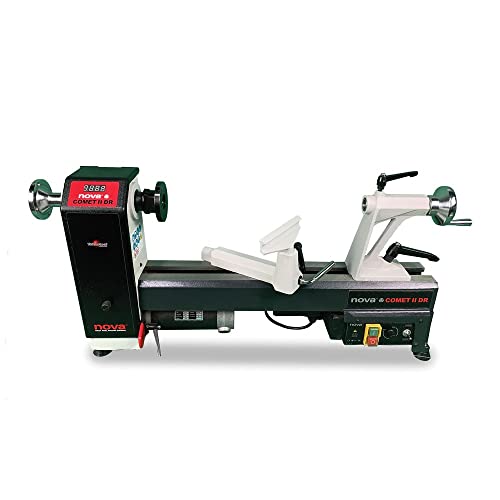
- Easiest Speed Control: NOVA Comet II DR. Best for beginners who want a simple dial, a readout and reverse.
- Most Capacity in the WEN Line: WEN 34035 + LA4444 Chuck Bundle. Best for a 14 x 20-inch work envelope from a budget brand.
- Best Budget: WEN LA3424. Best for learning spindles and small bowls on a modest budget.
- Cheapest Way to Try Turning: WEN LA3421. Best for pens and small spindles before you commit.
Comparison table
| Lathe | Best for | Swing | Between centers | Speed control | Lowest speed | Reverse | Amazon |
|---|---|---|---|---|---|---|---|
| JET JWL-1221VS | Buy once | 12-1/2 in. | 20-1/2 in. | Variable, 3 belt ranges | 60 RPM | Yes | Check price |
| JET JWL-1015VS | Small space | 10 in. | 15-1/2 in. | Variable, 3 belt ranges | 200 RPM | Not listed | Check price |
| RIKON 70-1516VSRK | Value | 12 in. | 16-1/2 in. | Variable, 3 belt ranges | 250 RPM | Yes | See options |
| NOVA Comet II DR | Simple controls | 12 in. | 16-1/2 in. | Electronic variable | 250 RPM | Yes | Check price |
| WEN 34035 + LA4444 chuck | Capacity | 14 in. (workpiece) | 20 in. (workpiece) | Variable | 250 RPM | Not listed | Check price |
| WEN LA3424 | Budget | 12 in. (workpiece) | 18 in. (workpiece) | 5 belt steps | 520 RPM | Not listed | Check price |
| WEN LA3421 | Trying it out | 8 in. | 13 in. | Variable dial | 750 RPM | Not listed | Check price |




"Not listed" means the manufacturer's spec sheet we checked does not mention reverse, so do not count on it.
The best beginner wood lathes, reviewed
1. JET JWL-1221VS: Best Overall for Beginners
Who it's for: beginners who are fairly sure turning will stick and want to avoid buying twice.
Three things make the 1221VS beginner-friendly. First, the 60 RPM floor lets you start an out-of-round blank barely moving and bring it up only once it runs smoothly, which is exactly the habit the AAW teaches. Second, the 1 HP motor and 12-1/2-inch swing (per retail spec sheets) handle spindles, boxes and bowls up to about 10 inches. Third, it uses the 1 in. x 8 TPI spindle and MT2 tapers that nearly every chuck, center and mandrel is made for.
JET's literature lists forward/reverse, a digital readout and 24 indexing positions. The three speed ranges (60–900, 110–1,800, 220–3,600 RPM) mean you will occasionally lift the cover and move the belt, which takes seconds. A bed extension brings it to about 43 inches between centers, and JET's five-year warranty covers the learning curve.
Pros
- 60 RPM start for safe roughing
- Reverse and digital readout
- Standard spindle and tapers
- Five-year warranty
Cons
- Belt changes between ranges
- Stand sold separately
- Overkill if you only turn pens

JET JWL-1221VS 12 in. x 21 in. Variable Speed Wood Lathe
by JET
2. JET JWL-1015VS: Best Small Starter Lathe
Who it's for: beginners with a small shop or apartment-sized space who mainly want pens, ornaments and spindles.
The 1015VS offers a 10-inch swing and 15-1/2 inches between centers, a 1/2 HP motor and variable speed in three ranges from 200 to 3,600 RPM. It has MT2 tapers, 24 indexing positions, a cast iron bed and a live center in the box. At about 78 lb shipping weight it is manageable on a sturdy bench.
You give up bowl capacity and power compared with the 1221VS, but not quality or warranty. Bowls up to about 7 inches are realistic.
Pros
- True mini footprint
- 200 RPM low end
- MT2 tapers and 24-position indexing
- Five-year JET warranty
Cons
- 1/2 HP motor limits bowl size
- Short bed for spindles
- Costs more than budget minis
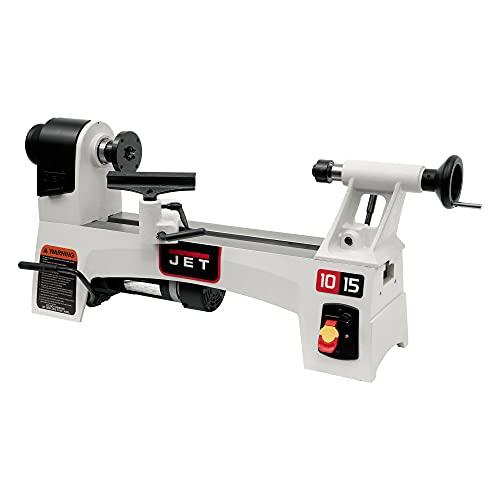
JET JWL-1015VS 10 in. x 15 in. Variable Speed Wood Lathe
by JET
3. RIKON 70-1516VSRK: Best Value
Who it's for: beginners who want a midi plus the chuck and accessories most new turners end up buying in the first month.
The 70-1516VSRK arrives ready for bowls. RIKON includes its Z3 four-jaw chuck with 2-inch jaws, spur and live centers, a 3-inch faceplate and a 6-inch tool rest on a 1-inch post. The lathe, per RIKON's spec page, offers 12 inches of swing, 16-1/2 inches between centers and a 1-1/4 HP brushless DC motor on 120V. Speed runs in three belt ranges (250–850, 430–1,450 and 950–3,200 RPM) with a dial within each, and it has forward and reverse, a digital readout and 24 indexing positions. The spindle is 1 in. x 8 TPI with MT2 tapers, it weighs 99 lb, and RIKON backs it for five years. A 13-1/2-inch bed extension (70-903) is available.
The 250 RPM minimum is the one real compromise for a beginner. Stick to dry, balanced blanks at first and it is not an issue.
Pros
- Four-jaw chuck, faceplate and centers included
- Reverse and digital readout
- Standard spindle and tapers
- Five-year warranty
Cons
- 250 RPM minimum
- Belt changes between ranges
- 16-1/2 inches between centers without the extension

RIKON 70-1516VSRK 12 in. x 16-1/2 in. VSRK Midi Lathe with Z3 Chuck System
by RIKON
Currently unavailable on Amazon
4. NOVA Comet II DR: Easiest Speed Control
Who it's for: beginners who want to turn a dial and watch a readout rather than move belts.
The Comet II runs from 250 to 4,000 RPM electronically, with a digital readout and a forward/reverse switch. Capacity is 12 inches of swing and 16-1/2 inches between centers, extendable to 42 inches. The 3/4 HP motor is fine for spindles, pens and bowls up to about 8 inches, and the hollow MT2 tailstock is handy for drilling.
It is light (about 77 lb shipping weight), so mount it on a heavy bench.
Pros
- Simple electronic speed dial and readout
- Forward/reverse
- 4,000 RPM top speed for pens
- Bed extension available
Cons
- 3/4 HP motor
- Shorter bed
- Light frame
5. WEN 34035 + LA4444 Chuck Bundle: Most Capacity in the WEN Line
Who it's for: beginners who want WEN's lowest-friction ownership but more room than its minis offer.
WEN rates the 34035 for workpieces up to 14 inches wide and 20 inches long. It has a 6-amp motor, variable speed from 250 to 3,550 RPM, a 1 in. x 8 TPI spindle and MT2 tapers. The box includes an MT2 spur center, an MT2 live center, an 8-inch tool rest and a 4-inch faceplate, which covers most of what a beginner needs to start. WEN describes it as a 120-plus-pound build and backs it for two years. On Amazon the 34035 is sold as a bundle with WEN's LA4444 4-inch four-jaw self-centering chuck (1 in. x 8 TPI, with a screw chuck), so a starter chuck comes in the same order.
WEN does not publish a horsepower figure, and the 14-inch rating is a maximum, not a comfortable working size. It is priced closer to midi lathes from JET and RIKON than to WEN's own minis, so compare carefully.
Pros
- Largest work envelope here
- Live center and faceplate included
- Bundled with a 4-inch four-jaw chuck
- Variable speed down to 250 RPM
- Standard spindle and tapers
Cons
- Two-year warranty
- No published horsepower
- Priced near better-supported midis

WEN 34035 6-Amp 14-Inch by 20-Inch Variable Speed Benchtop Wood Lathe & LA4444 4-Inch 4-Jaw Self-Centering Chuck Set
by WEN
6. WEN LA3424: Best Budget
Who it's for: beginners who want to learn spindle turning and small bowls for the least money with standard MT2 tapers.
The LA3424 takes workpieces up to 12 x 18 inches, runs a 4.5-amp motor at five belt speeds (520, 900, 1,400, 2,150 and 3,400 RPM), and has MT2 in both the headstock and tailstock. WEN lists it as compatible with its 1 in. x 8 TPI chucks. It comes with a 3-1/8-inch faceplate and centers.
Five fixed speeds teach you to think about speed, which is no bad thing, but the 520 RPM bottom speed means bowls should stay small and balanced.
Pros
- Budget price tier
- MT2 tapers
- Faceplate included
- Simple to maintain
Cons
- Belt changes for every speed change
- 520 RPM minimum
- Light build

WEN LA3424 4.5-Amp 12-Inch by 18-Inch 5-Speed Benchtop Wood Lathe
by WEN
7. WEN LA3421: Cheapest Way to Try Turning
Who it's for: curious beginners who want to try pens and small spindles before investing.
The LA3421 is an 8-inch swing, 13-inch-between-centers mini (per WEN's current listing) with a 3.2-amp soft-start motor and dial-controlled variable speed from 750 to 3,200 RPM. Two tool rests and a small faceplate are included. Note the MT1 tapers: buy MT1 mandrels and centers, or adapters.
Think of it as a pen and spindle lathe. At 750 RPM minimum, it is not a bowl machine.
Pros
- Lowest cost of entry
- Variable speed dial
- Two tool rests included
- Small and light
Cons
- MT1 tapers
- 750 RPM minimum
- Limited capacity and power

WEN LA3421 3.2-Amp 8-Inch by 13-Inch Variable Speed Mini Benchtop Wood Lathe
by WEN
Buying guide: what a beginner actually needs
A low starting speed
This is the most important spec for a beginner. The AAW's Safety Guidebook for Woodturners says that if you wonder whether the speed is too high, it probably is. It suggests about 1,000 RPM or less for spindle stock 4 inches and larger, and it cautions that the old bowl formula (diameter in inches x RPM = 6,000 to 9,000) can be too fast for unbalanced blanks. A lathe that starts at 60 or 200 RPM gives you a safety margin that a 750 RPM lathe cannot.
Standard spindle thread and MT2 tapers
Every accessory you buy depends on these. The AAW notes that MT2 is the most common taper on woodturning lathes, and 1 in. x 8 TPI is the standard thread on small and midi lathes. Stick with them and chucks, faceplates, live centers and pen mandrels fit without adapters.
Capacity you will grow into
Pens need almost nothing. Bowls are where capacity matters. A 12-inch swing lets you turn bowls up to about 10 inches, which covers most first-year projects. See our best mini wood lathes if space forces you smaller, or the best wood lathe guide if you already know you want big bowls.
Mass, stand and height
A wobbly stand makes any lathe feel worse. The AAW's guideline puts spindle height around the height of your heart and no lower than your elbow. Most beginners set their lathe too low and end up with back pain.
Warranty and support
JET offers five years. WEN offers two. Laguna offers two on new machines. A longer warranty matters more for beginners, who are more likely to stall a motor or crash a tool rest.
Your day-one starter kit
The lathe is only part of the cost. Plan for these too:
- Full face shield. The AAW strongly recommends wearing one whenever the lathe is on, not just safety glasses.
- Dust protection. A dust mask or respirator plus dust collection at the lathe, especially when sanding.
- Turning tools. A spindle roughing gouge, a spindle gouge, a parting tool, a skew and, for bowls, a 3/8- or 1/2-inch bowl gouge. Our wood lathe tools guide covers sets for every budget.
- A way to sharpen. High-speed steel tools need regular sharpening. The AAW suggests a slow-speed grinder (about 1,750 RPM) over a typical 3,600 RPM bench grinder. Not sure you want to sharpen? See carbide or HSS for beginners.
- A four-jaw chuck, once you move on to bowls and boxes. See the best wood lathe chucks.
- Sound, dry wood. Avoid cracks, knots and bark inclusions while you learn, per AAW guidance.
Then work through our woodturning basics for beginners and pick something from our beginner lathe projects.
How we chose
We did not test these lathes ourselves. We compared manufacturer and retailer spec sheets for models currently sold in the US, and we ranked them using the criteria the AAW emphasizes for safe learning: low starting speed, standard tapers and threads, and adequate mass. We also weighed warranty length and parts support. Where a spec could not be confirmed from the manufacturer, we left it out or marked it "not listed."
FAQ
What is the best wood lathe for beginners?
The JET JWL-1221VS is our top pick because it starts as slowly as 60 RPM, has reverse and a digital readout, uses the standard 1 in. x 8 TPI spindle and MT2 tapers, and carries a five-year warranty. It is big enough that most beginners never outgrow it for spindle work and small bowls.
Should a beginner buy a mini or a midi lathe?
Buy a midi (about 12-inch swing, 3/4 to 1 HP) unless you only want to turn pens and small spindles or you are very short on space. A midi costs more, but it handles bowls and is the size most beginners end up wanting within a year.
Is woodturning hard to learn?
The basics come quickly with good instruction. Most people can turn a simple spindle in their first session. Sharpening and controlling the bowl gouge take longer. The AAW recommends learning from an experienced instructor, video or book, and it points beginners to local chapters for classes.
What else do I need besides the lathe?
At minimum, a full face shield, a dust mask or respirator, a basic set of turning tools, a way to sharpen them, and some sound, dry wood. A four-jaw scroll chuck is the first big accessory most turners add, especially for bowls.
Is a cheap lathe good enough to learn on?
A budget lathe can teach you spindle turning and pens. Its limits are a high minimum speed, fewer accessories and less mass, which make bowl turning harder and less safe. If bowls are your goal, a midi lathe with a low starting speed is worth the extra cost.
Verdict
For most new turners, the JET JWL-1221VS is the best wood lathe for beginners: slow enough to start safely, standard enough that every accessory fits, and capable enough to keep for years. If space or budget is tight, the JET JWL-1015VS is the best true mini, and the WEN LA3424 is the sensible budget choice for spindles and small bowls.
Related: see our WEN lathe review.